

Autumn Leaves – Bass Arrangement Study (Tabs + Learning Guide)
This bass arrangement of Autumn Leaves is designed as a focused study for developing walking basslines. The arrangement highlights practical musical concepts that help bassists understand how lines function within real musical settings.
What This Arrangement Teaches
1. Outlining Harmony Through Arpeggios
Strong walking bass lines clearly define the harmony by emphasizing chord tones. Arpeggios provide the primary framework for this process, allowing bassists to outline each chord while maintaining forward motion. In this study, most measures are built from arpeggiated chord tones, reinforcing the skill of hearing and navigating harmony directly from the bass.
2. Smooth Voice Leading Between Chords
Effective walking lines “flow” because of voice leading—connecting chords using the nearest available tones. This often involves moving by half step, whole step, minor third, or major third into the next chord tone. Practicing these short interval connections helps bassists create lines that sound intentional, smooth, and harmonically connected across the progression.
3. Practical Use of Chromatic Passing Tones
Chromatic notes are frequently used to connect chord tones that are a whole step apart. In walking bass playing, these notes are often placed as passing tones on weaker beats or as eighth-note approaches, helping maintain forward motion while avoiding sustained dissonance. This arrangement demonstrates how chromatic approaches can create momentum and clarity when leading into the next chord tone.
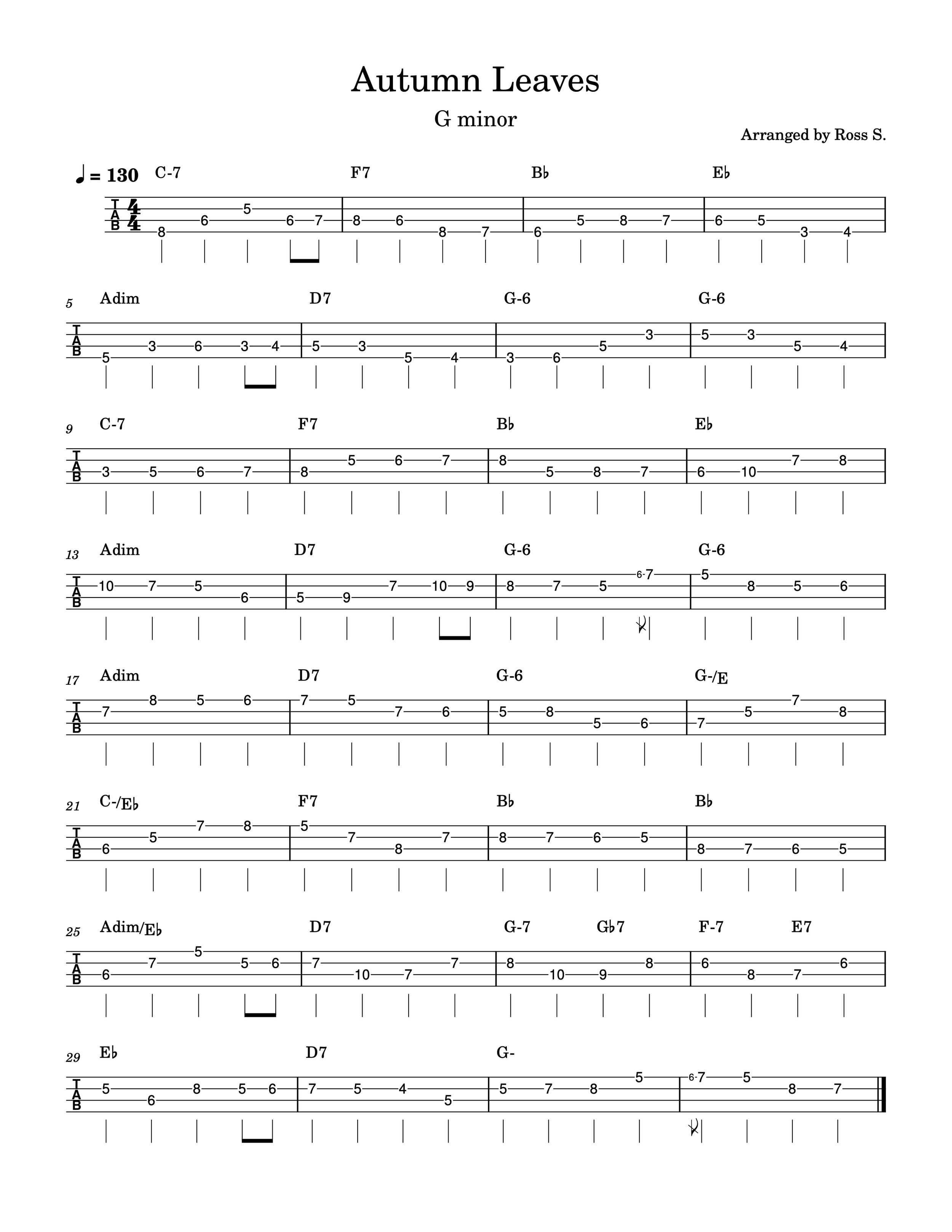
Autumn Leaves Bass Study
Practice Suggestions
Practice Slowly First
Begin at a slow tempo to ensure each note clearly outlines the harmony and feels rhythmically consistent. Gradually increase tempo only after the line feels relaxed and controlled.Learn the Line in Small Chunks
Work in short sections of 2–4 measures at a time, looping each segment repeatedly until it feels mechanically comfortable and memorized. Once each section is secure, connect the chunks to build the full progression.Analyze the Harmony and Scale Degrees
Identify how each note relates to the chord: root, third, fifth, seventh, or chromatic approach tone. Understanding the scale-degree function helps you see the logic behind the line rather than memorizing shapes.Create Your Own Variations
After identifying the chord tones and approaches, experiment by changing the order, direction, or rhythmic placement of the same harmonic tones. This helps you develop new walking bass ideas while staying grounded in the same harmonic structure.
Studies like this reflect the same groove, harmony, and musical literacy concepts taught in my Atlanta and online bass lessons, where students learn how to build bass lines, understand harmony, and perform confidently in real musical settings.