

Jazz Harmony in Hip-Hop Bass: Wayne Shorter’s “Footprints” Influence on So Fresh, So Clean (Part 2)
If you found this through a search for hip hop bass lessons or hip hop bass lessons in Atlanta, this is Part 2 of a deeper dive into where that groove actually comes from. In Part 1, we looked at syncopation and chord vamps in So Fresh, So Clean. Here, we go one level deeper by tracing a specific jazz quotation hidden inside that same bass line.
This kind of cross-genre translation, finding the jazz DNA inside a hip hop groove, is exactly the lens Groove Lab is built around: not just learning bass lines, but understanding why they work.
The Jazz Vamp and Its Influence on Hip-Hop Harmony
One of the clearest harmonic connections between jazz and hip-hop is the concept of the vamp, as discussed in part 1.
In modal and funk jazz, a vamp is a repeating two-chord progression that establishes a tonal center while allowing space for rhythmic and melodic development. This structural approach has had a direct influence on hip-hop harmony.
In So Fresh, So Clean, the progression closely resembles the vamp from Footprints by Wayne Shorter.
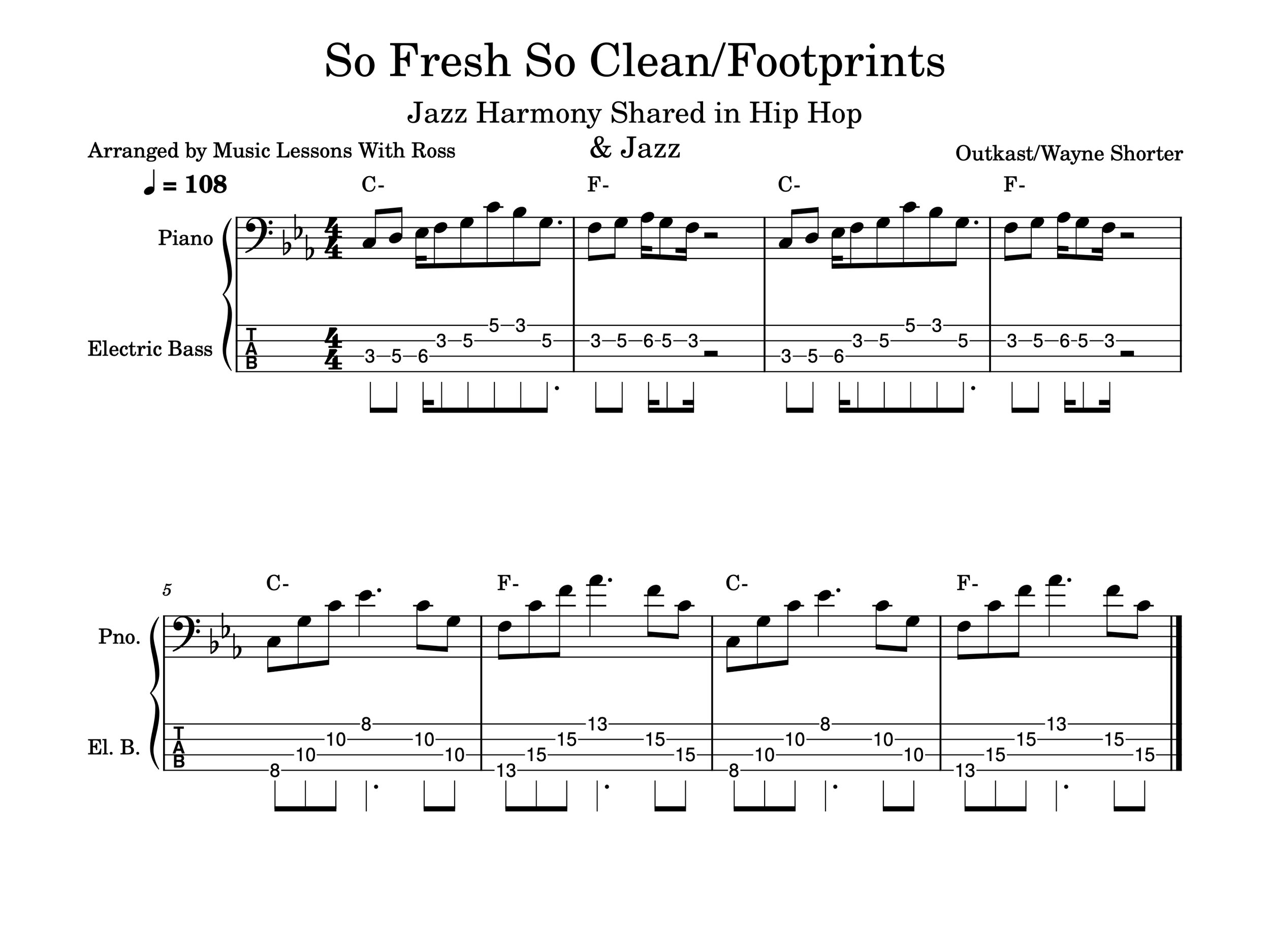
For this study, I took the ostinato pattern from Footprints, adjusted it into 4/4 time, and applied it to So Fresh, So Clean. The result highlights how jazz harmonic devices translate naturally into hip-hop contexts.
Using Minor 10ths to Create Open Jazz-Inspired Bass Lines
What makes the Footprints ostinato particularly compelling is how it outlines harmony. The voicing resembles the way a jazz pianist might structure a chord rather than how bassists traditionally outline one.
Instead of a simple root–third–fifth sequence, the pattern follows:
Root – Fifth – Octave – Minor 10th – Octave - Fifth
Applied to both C minor and F minor, this ordering introduces a key difference: the minor third placed above the octave.
Reordering Chord Tones for Modern Hip-Hop Groove
This spacing creates a more open, resonant sound. There is greater distance between chord tones, which results in a broader harmonic texture — something often associated with jazz piano voicings.
For bassists, this presents an important opportunity:
Experiment with the intentional ordering of chord tones.
Move beyond sequential arpeggios.
Explore wider interval spacing for tonal depth.
Borrow structural ideas from jazz standards and apply them to hip-hop grooves.
The shared harmonic language between jazz and hip-hop makes this crossover especially powerful.
These types of harmonic concepts are exactly what we explore in the Groove Lab, all designed to help you write better hip hop bass lines.
Reflection
Use these questions to internalize how chord-tone ordering shapes the emotional character of a bass line:
What changes when you place the minor third above the octave instead of within the first octave?
Try playing the So Fresh, So Clean bass line with a standard root-third-fifth arpeggio, then with the Footprints-inspired voicing. What's different about how each one feels?
Where else in your own playing do you default to sequential arpeggios out of habit rather than intention?