

Groove and Jazz Harmony in Hip Hop (Part 1)
Why Bassists Should Study Hip Hop
If you've searched for Hip Hop bass lessons or Hip Hop bass lessons in Atlanta, you're probably looking for more than a collection of songs to memorize. You're trying to understand what makes hip hop bass lines feel so good.
Why does a simple bass line lock in so deeply with the drums? How do repetition, space, rhythm, and harmony work together to create a groove that feels effortless?
Those are the questions we explore throughout Groove Lab.
Groove & Harmony
Hip hop is one of the richest musical traditions for studying bass because it places groove at the center of the music. Rather than relying on constant harmonic movement or technical complexity, many of the genre's most memorable bass lines create momentum through rhythm, note placement, repetition, articulation, and subtle harmonic color.
This lesson explores how jazz harmony helped shape the language of hip hop bass and why understanding that relationship can make you a more creative bassist. Instead of simply learning what notes to play, you'll begin to understand why hip hop bass lines work, and how those same principles can influence your own playing, songwriting, and improvisation.
Arranging the Melody of So Fresh, So Clean for Bass
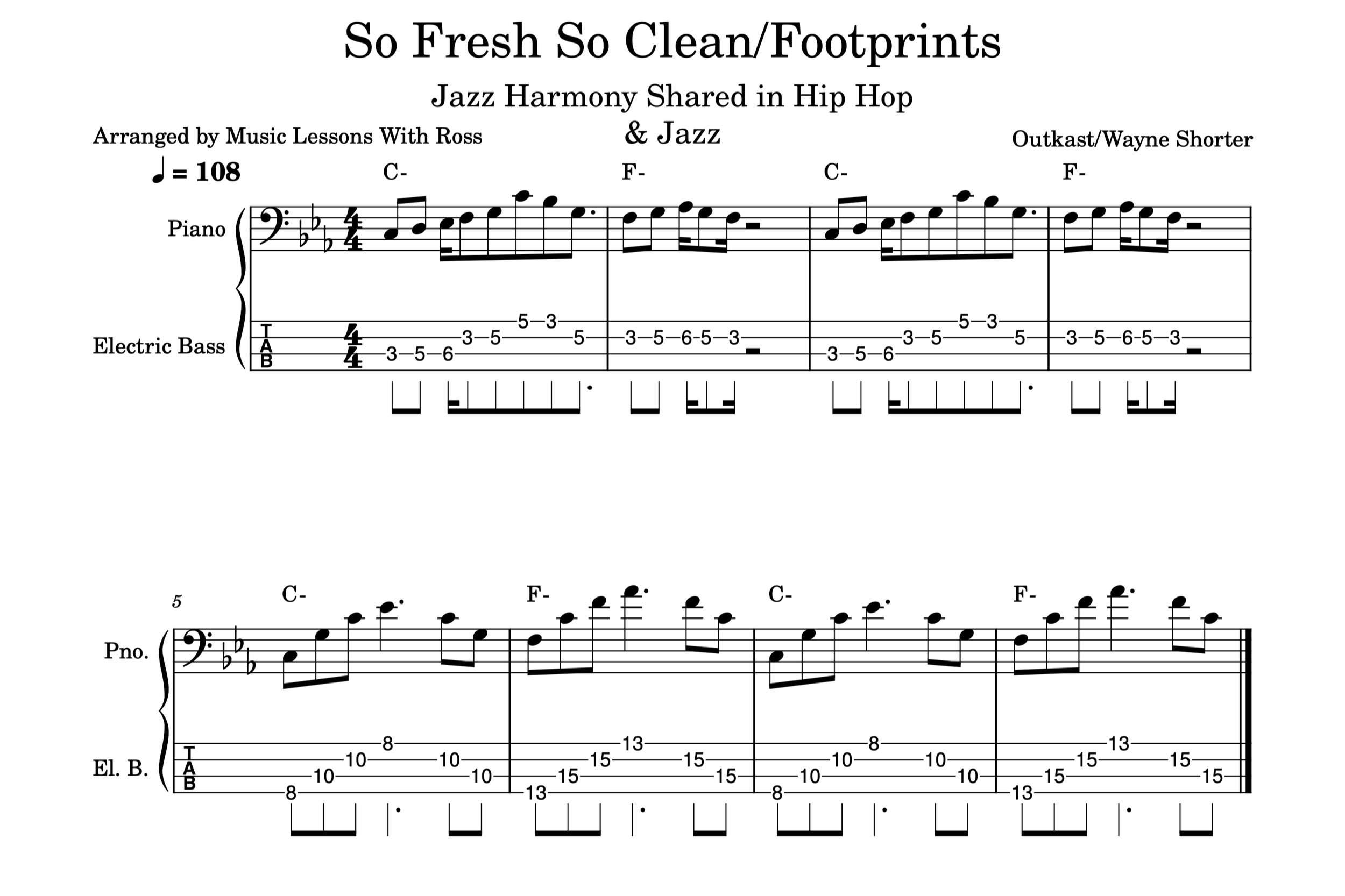
In this study, I’ve arranged the melody of So Fresh, So Clean by Outkast for bass guitar in order to examine how groove and jazz harmony inform hip-hop composition.
Groove Construction
From a groove standpoint, which is what we explore in the Groove Lab, the song relies heavily on syncopation — not merely in the sense of playing “off” the beat, but in creating tension against the underlying drum pattern.
The melody is built primarily from steady 8th-note phrasing, with relatively sparse use of 16th notes. On its own, this might suggest rhythmic stability. However, the drum groove leaves noticeable space on beats two and four. This creates a subtle but powerful rhythmic contrast: the melodic line sustains forward motion while the drums articulate space.
This push-and-pull relationship is deeply rooted in jazz phrasing traditions, where rhythmic tension is often created not by density, but by strategic placement against the rhythm section. Hip hop inherits this structural and aesthetic influence, particularly in its emphasis on pocket, space, and conversational interaction between musical layers.
Rather than thinking of syncopation as “off-beat,” it is more accurate to think of it as rhythmic counterpoint — a deliberate dialogue with the drum groove.
Harmonic Function
Harmonically, So Fresh, So Clean is built around a two-chord vamp in the key of E♭ major. A vamp, or repeating harmonic loop, provides a stable tonal environment over which rhythmic variation becomes the primary expressive device.
The use of static harmonic movement is another direct lineage from jazz — particularly modal and funk-influenced traditions.
For example, modal jazz frequently relies on extended vamps rather than fast-moving chord progressions. A clear example is Impressions by John Coltrane, which sustains long stretches of D minor tonality to allow rhythmic and melodic development to take center stage.
Similarly, many hip-hop producers have sampled jazz recordings built on vamp-based harmony. A notable example is Swahililand by Ahmad Jamal, which was famously sampled in Stakes Is High by De La Soul, produced by J Dilla.
In both jazz and hip hop, the harmonic simplicity of a vamp shifts expressive focus toward:
Rhythmic nuance
Tone and articulation
Micro-timing
Melodic development
When arranging the melody of So Fresh, So Clean for bass, this static harmonic framework allows us to focus on phrasing, note length, and rhythmic interaction with the drums rather than complex chord navigation.
Another song explored in the Groove Lab that uses a two chord vamp is King Kunta, be sure to download the accompanying hip hop bass arrangement.
Reflection
The goal of the Groove Lab Reflection isn't simply to add new ideas that are interesting. It’s to integrate and internalize the concepts that make bass lines memorable and fun to listen to.
Use the questions below to reflect on your comprehension of the two core ideas, syncopation and chord vamps.
Syncopation
What is syncopation and does it show up in this arrangement?
Which rhythmic ideas created the greatest sense of movement?
How did syncopated notes change your perception of the groove compared to notes played directly on the beat?
Were there moments where anticipation or delayed resolution made the phrase feel more expressive?
If you simplified the rhythm, what musical effect would be lost?
Chord Vamp
What is a chord vamp and how is it used in this arrangement?
How did the repeated harmonic progression influence your rhythmic decisions?
Did the static harmony make you focus more on articulation, rhythm, or note duration?
How might you approach this bass line differently if the chords changed every measure?
What opportunities does a chord vamp create that a rapidly changing progression does not?
In Part 2, I’ll explore how I’ve quoted the bass line from a famous Modal Jazz song from Wayne Shorter inside the track of So Fresh So Clean. Including notation and in depth analysis.