
Hip Hop Bass Lines: King Kunta
Most bass players approach hip hop bass lines by focusing on the notes first.
But on tracks like “King Kunta” by Kendrick Lamar, the groove does most of the work.
The bass line isn’t complex harmonically, but the feel, placement, and interaction with the drums create the identity of the track.
This is where a lot of players struggle.
They can identify the notes, but the groove doesn’t translate.
In this lesson, we’re going to break that down in a practical way.
We’ll start by analyzing the original bass line—focusing on rhythm, phrasing, and how it locks in with the drums.
Then, we’ll take those concepts and apply them to a new arrangement, using the same musical context as a foundation for writing a fresh bass line.
The goal isn’t just to learn this part.
It’s to understand how to build hip hop bass lines that feel right.
First let’s listen to the original bass line in context
Rhythmic Analysis
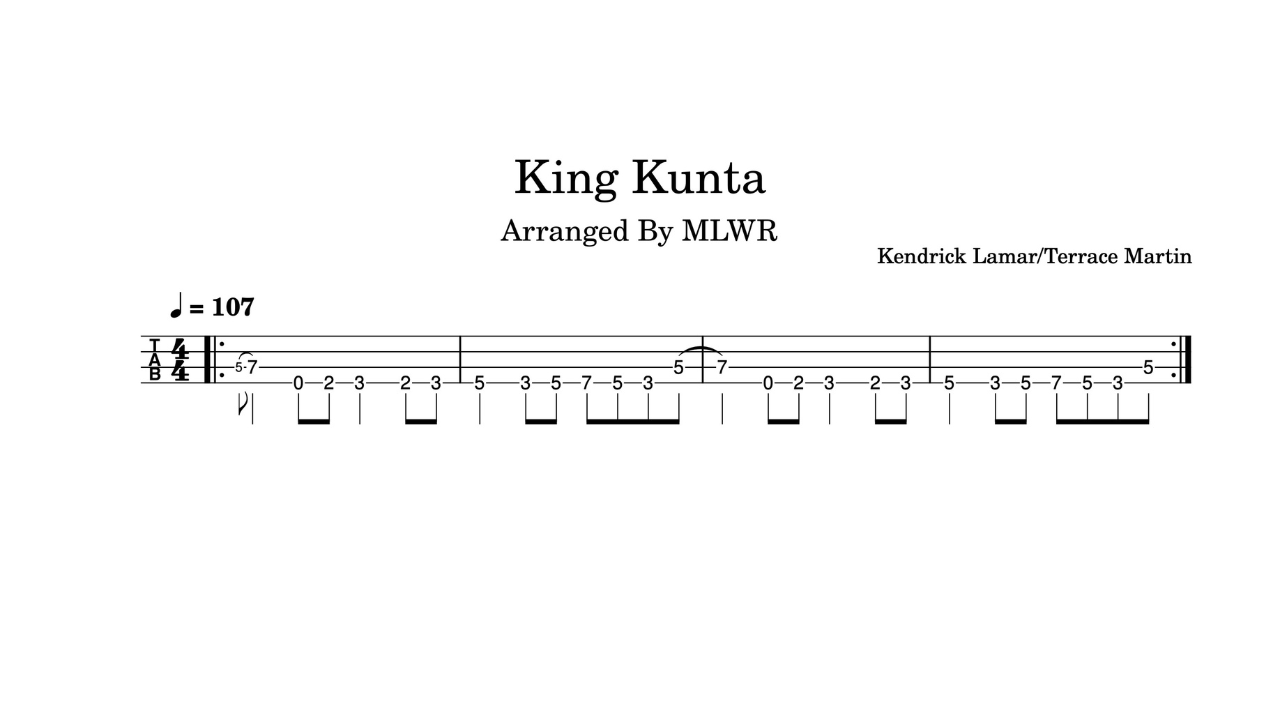
The groove on “King Kunta” by Kendrick Lamar is built around a repeating two-bar phrase, centered on a simple motif: a quarter note followed by two eighth notes.
On paper, that’s straightforward.
What makes it work is where those eighth notes land.
They consistently fall around beats 2 and 4, creating a sense of anticipation that pushes into the next downbeat. This placement gives the line its forward motion and contributes directly to the track’s “bounce.”
Just as important is how the bass locks in with the kick drum pattern (1, 2+, 3, 4).
The alignment between the bass phrasing and the kick is what stabilizes the groove. Even when the rhythm feels slightly pushed, that relationship keeps everything grounded.
The phrase resolves with an eighth note that glissandos into the next downbeat.
That detail matters.
It’s not just a transition—it reinforces the cyclical nature of the groove and keeps the line feeling connected across phrases.
This is a clear example of how a simple rhythmic idea, when placed intentionally, can define the feel of an entire track.
Harmonic Analysis
Harmonically, “King Kunta” by Kendrick Lamar is built on a two-chord vamp: E minor to F# minor, suggesting a broader context of D major.
On the surface, this is a simple progression.
What makes it effective is how the bass line uses motion and placement to create interest without overcomplicating the harmony.
The phrase begins with a glissando from the flat 7 up to the octave. This is played on the A string rather than the D string, keeping the line in a lower register and maintaining a deeper, more consistent timbre that blends with the groove.
From there, the line outlines the chord using familiar scale motion:
root to 9 (eighth notes)
resolving to the minor 3rd (quarter note)
This is straightforward, but intentional. The clarity of these chord tones grounds the groove.
The next movement introduces subtle variation:
a quick return to the 9
followed again by the minor 3rd
Even without using blue notes, the line maintains forward motion by consistently pushing toward the next downbeat.
That motion becomes more apparent at the transition into the second measure.
The line lands on A, which functions as the minor 3rd of F# minor. This is a clear example of voice leading—connecting the harmony smoothly from one chord to the next without breaking the flow of the groove.
From here, the same melodic concept is developed further.
A short ascending figure (G → A → B) introduces additional color:
G (flat 9)
A (minor 3rd)
B (11th)
This is one of the few moments where the line expands harmonically, adding tension and color while still staying connected to the chord.
At the same time, the rhythm briefly shifts—moving away from the original motif into a run of consecutive eighth notes.
That change matters.
It creates contrast within the phrase, preventing the groove from becoming static while still maintaining overall cohesion.
The line then descends (B → A → G), before landing on D (flat 13), which glissandos back into the octave—resetting the phrase and reinforcing the loop.
Why This Works
This bass line is a strong example of how simple harmony can feel rich through motion, phrasing, and voice leading.
It doesn’t rely on complex chord changes.
Instead, it develops interest through:
clear chord outlining
stepwise motion
strategic use of extensions
and smooth transitions between chords
For bass players, this is the key takeaway:
👉 You don’t need more chords, you need better connection between them.
That’s what creates a bass line that feels both grounded and musical within a modern hip hop groove.
Writing our own Hip Hop Bass Line using the Groove Lab system
Now that we’ve learned and analyzed what was played on King Kunta, we can use the Groove Lab system to transform this bass line into something new
Rhythmic selection
What’s already working rhythmically is that the bass line is tied to kick drum and blends ¼ note and 1/8 note phrasing. This results in the bass anchoring the groove and creating a subtle “bounce”.
What we want to change, let’s add more dramatic “bounce” and “head nod” in the feel, without losing the vibe that already exists.
We can achieve those goals by adding in intentional rests, creating syncopation that is less predictable and more musical. We can also add staccato phrasing to our bass line, which gives more room for the kick and snare to breathe.
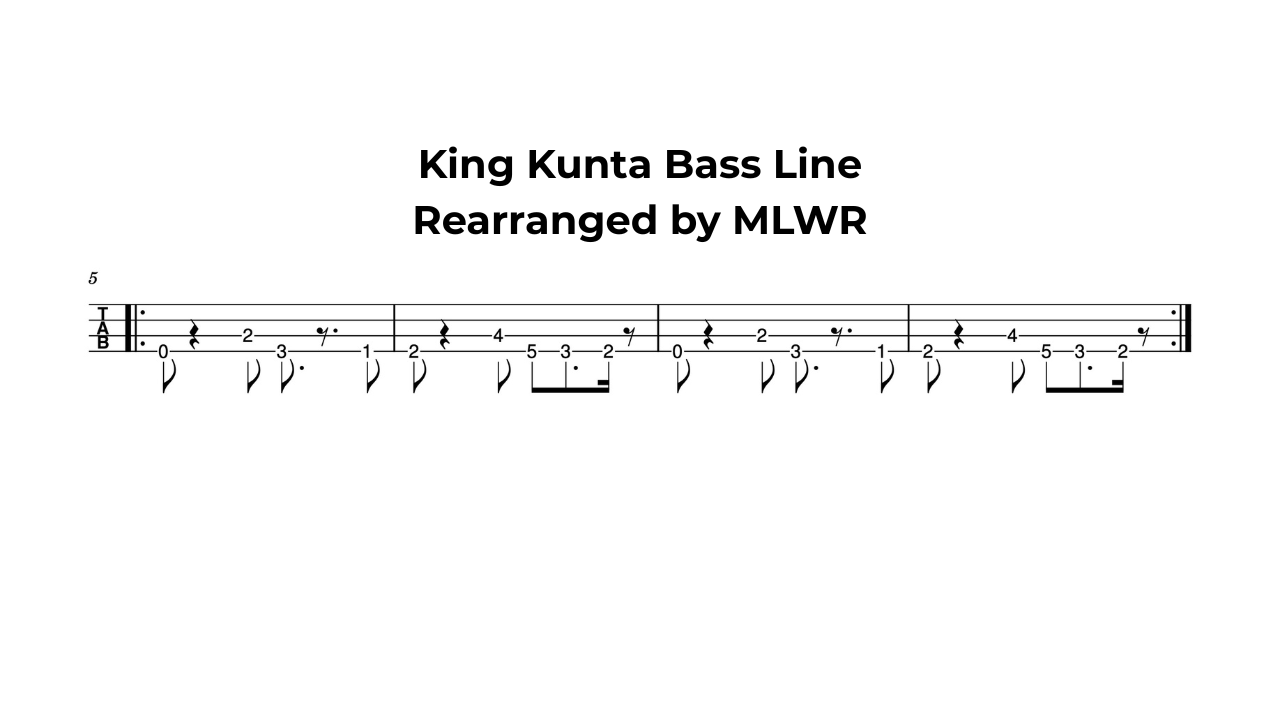
On beat 1, play an 1/8-note pulse that locks tightly with the kick.
The “+” of beat 1 and the downbeat of beat 2 are rests. This creates space for the snare to speak clearly and allows the groove to breathe.
The “+” of beat 2 plays an 1/8-note pulse, creating anticipation into beat 3.
On beat 3, play a dotted 1/8 note (equivalent to three 1/16 notes). This creates a slightly extended rhythmic feel that pushes against the grid in a controlled, musical way.
The last 1/16 of beat 3 is a dotted 1/8 rest, lasting three 1/16 notes and carrying us from the end of beat 3 into the downbeat of beat 4.
On the “+” of beat 4, play an 1/8 note, creating lift and forward motion into the next measure.
Measure 2 repeats this same rhythmic idea through beat 2.
On beat 3 of measure 2, play an 1/8 note followed by a dotted 1/8 note, which displaces the next articulation so that it lands on the “e” of beat 4.
The “+” of beat 4 is an 1/8-note rest, leaving space before the cycle resolves into the next bar.
The use of intentional note duration, syncopation, 1/16 note phrasing, adding in purposeful rests all create a stronger hitting groove.
These are all ideas explored by the producer J Dilla, read this lesson to learn more about creating hip hop bass grooves.
Harmonic selection
When choosing notes for a hip hop bass line, every note should serve one of three functions:
Outline the chord
Lead by half-step into the next note
Extend the harmony (chord tones beyond the triad)
This framework shifts your playing from guessing or relying on patterns → to intentional note placement that controls tension and release.
What’s already working in this line is the use of:
extensions
stepwise motion (moving through the scale in sequence)
These elements help round out the harmony and connect the bass line to the rest of the band.
What We Want to Improve
Because the rhythm has become more complex, the harmony needs to simplify.
We’ll:
reduce the number of extensions
keep stepwise motion where it supports the line
This creates clarity and balance between rhythm and harmony.
Measure 1 Breakdown
Beat 1 (downbeat): E
The root of the chord. This clearly establishes the tonal center and grounds the listener.“+” of Beat 2: B
The 5th of the chord. Strong, stable chord outlining.Beat 3 (downbeat): G
The minor 3rd. This completes the core triad and reinforces the chord quality.“+” of Beat 4: F
This note is outside the key and chord.
It functions as a chromatic leading tone, pulling into the next measure.
Measure 2 Breakdown
Beat 1 (downbeat): F#
The root of the new chord.
The resolution from F → F# is a classic chromatic approach, commonly used in hip hop bass lines.“+” of Beat 2: C#
The 5th of the chord. Clear harmonic support.Beat 3 (downbeat): A
The minor 3rd. Again, completing the triad.
At this point, we’ve repeated the same structure from measure 1:
👉 Root → 5th → minor 3rd
This repetition creates cohesion and stability, giving the listener something consistent to latch onto.
Where the Line Evolves
“+” of Beat 3: G
Using a descending line with stepwise motion“e” of Beat 4: F#
This creates a smooth, connected motion back into the root.
Key Takeaway
This line demonstrates an essential principle:
As rhythmic complexity increases, harmonic complexity should decrease.
We maintain:
strong chord outlining (root, 5th, minor 3rd)
stepwise motion for connection
But reduce:
unnecessary extensions
The Result
clearer groove
stronger harmonic foundation
more intentional phrasing
Instead of filling space, every note now has a defined role in shaping the line.
Continue the study
With the downloadable King Kunta Bass Tab Worksheet, a Groove Lab resource focused on groove, phrasing, articulation, and harmonic movement in modern hip hop bass playing.