
Walking Bass Concepts in How High the Moon — Bass Arrangement Analysis
This walking bass arrangement focuses on voice leading, enclosures, diminished substitutions, and functional harmony to demonstrate how professional bass lines create forward motion through jazz standards. The concepts below highlight how specific harmonic tools shape melodic direction, tension, and resolution across the form.
Core Concept Categories
1. Enclosures
Enclosures create melodic tension by surrounding a target note before resolving to it, strengthening harmonic clarity and line momentum.
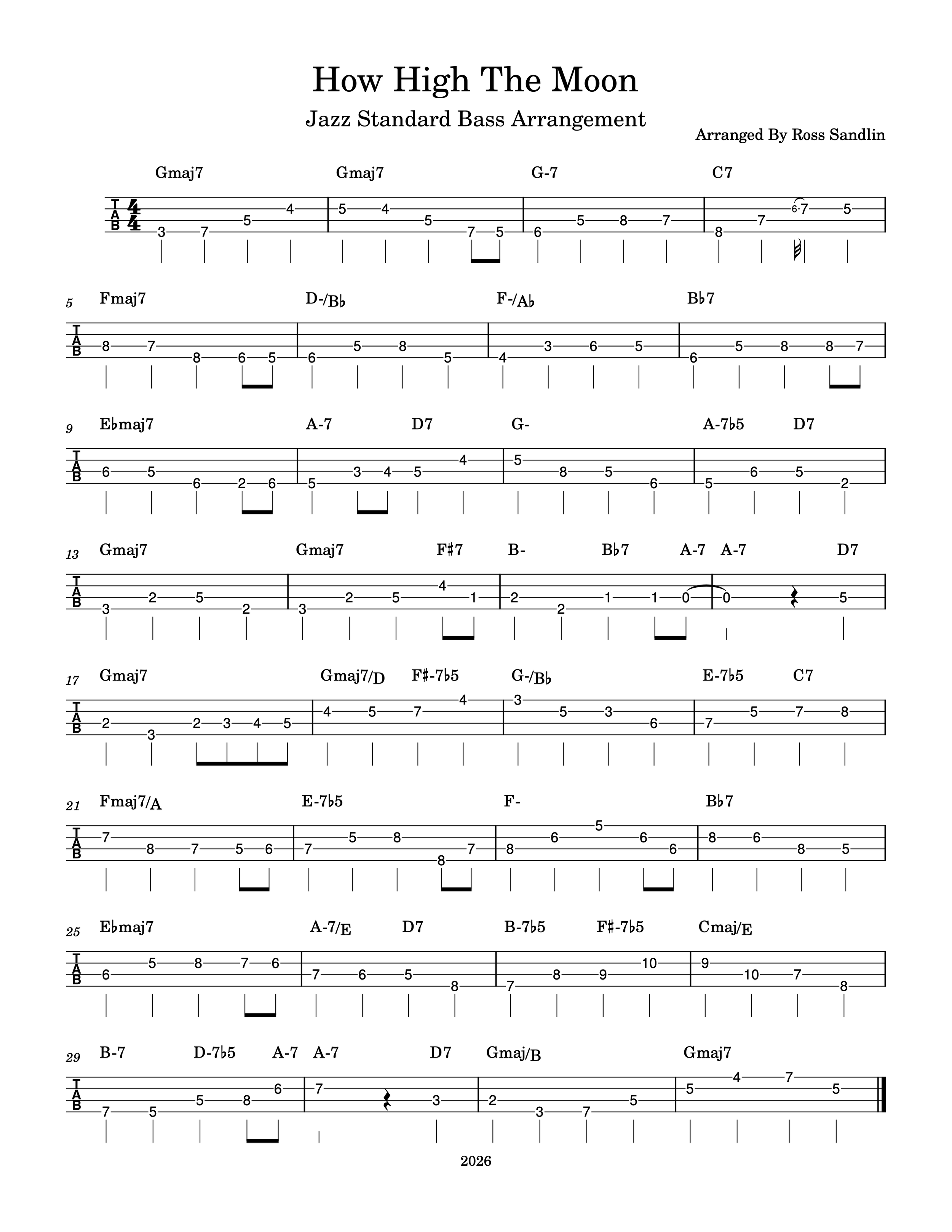
Measures using enclosures
Measure 2 – Enclosure approaches the B♭ in measure 3, selected for smooth voice leading.
Measure 5 – Enclosure reinforces harmonic movement into the substituted harmony.
Measure 9 – Enclosure anticipates the upcoming A in measure 10, creating forward momentum.
Why it matters:
Enclosures improve melodic direction and help walking bass lines sound intentional rather than scalular.
2. Common Chord Substitutions
Common chord substitutions introduce chromatic movement while maintaining functional harmonic direction.
Measures using substitutions
Measure 5: Fmaj7 → Dm over B♭
Measure 18: Gmaj7 → F#dim
Measure 20: C7 → Edim
Measure 22: Fmaj7 → Edim
Measure 27: Two diminished chords used as common chord substitutions
Measure 29: B♭7 → Ddim
Why it matters:
Diminished passing harmonies create smoother bass movement and richer harmonic color without disrupting progression function.
3. Voice Leading and Inversions
Voice leading ensures that bass lines connect chords smoothly using the nearest available chord tones, often reinforced through inversions.
Measures demonstrating voice leading or inversion
Measure 6 → 7: Stepwise voice leading transitions into a chord inversion in measure 7.
Measure 3: Target tone (B♭) chosen specifically for voice-leading continuity.
Multiple substitution measures: Chromatic diminished substitutions reinforce descending voice-leading motion.
Why it matters:
Strong voice leading allows walking bass lines to “flow” naturally across the progression rather than sounding disconnected.
4. Secondary Dominant Function
Secondary dominants temporarily tonicize upcoming harmonies to increase tension before resolution.
Measure using secondary dominant
Measure 14: F#7 introduced as a secondary dominant to strengthen harmonic pull.
Why it matters:
Secondary dominants create forward drive and reinforce functional harmony awareness in jazz bass playing.
Educational Takeaway
This arrangement demonstrates how professional walking bass lines rely on intentional harmonic decision-makingrather than scale-based note selection alone. By combining enclosures, diminished substitutions, voice leading, inversions, and secondary dominants, bassists can create lines that clearly outline harmony while maintaining strong rhythmic flow.
Practice Applications: Internalizing Walking Bass Concepts
Use the following exercises to apply the harmonic and voice-leading ideas demonstrated in this arrangement. Practicing these concepts in isolation first will make them easier to recognize and apply in real performance settings.
1. Enclosure Practice
Select a target chord tone (root, 3rd, 5th, or 7th).
Approach the note using upper and lower neighboring tones before resolving.
Practice over a static chord first, then apply to moving progressions.
Create at least three enclosure variations for the same target tone to develop flexibility.
Goal: Develop the ability to intentionally emphasize harmonic targets while maintaining melodic interest.
2. Common Chord Substitution Practice
Identify measures in the progression where diminished substitutions occur.
Practice alternating between:
The original chord
The substituted diminished chord
Listen carefully to how chromatic movement changes the sense of forward motion.
Goal: Build awareness of how substitutions create tension while preserving functional harmony.
3. Voice Leading and Inversion Practice
Practice connecting chord tones using the smallest possible interval movement (half step, whole step, or minor third).
Play the same progression multiple times, each time starting from a different inversion of the chord.
Focus on smooth horizontal motion rather than jumping between roots.
Goal: Train the ear and hands to prioritize smooth harmonic connection rather than root-only thinking.
4. Secondary Dominant Recognition
Isolate the section containing the secondary dominant.
Practice emphasizing the guide tones (3rd and 7th) of the dominant chord before resolving.
Experiment with chromatic approach notes leading into the resolution chord.
Goal: Strengthen recognition of temporary tonicization and its role in harmonic tension.
5. Chunk-Based Mastery
Practice 2–4 measures at a time, looping each section until the movement feels automatic.
Analyze each chunk:
What are the chord tones being targeted?
Where are enclosures used?
Which notes create voice-leading continuity?
Once comfortable, reconnect the chunks into the full form.
Goal: Build reliable muscle memory while reinforcing harmonic understanding.
6. Creative Expansion Exercise
Rewrite one measure of the line using:
A different enclosure pattern
A different inversion
An alternative chromatic approach
Compare the musical effect and decide which version creates the strongest motion.
Goal: Move from imitation to controlled creative application.
Key takeaway:
Practicing walking bass effectively means analyzing why each note functions the way it does. When enclosures, substitutions, and voice leading are practiced intentionally, bass lines become clearer, more melodic, and harmonically supportive across any jazz standard.