
Composition, Collaboration, Completion: Breaking Down How ‘Smell The Flowers’ Was Made
There is a gap that exists in most music education, because the primary goal is focused on the performance of existing material. The flow looks something like this; teacher picks popular music for the instrument they teach, they walk student through each note and measure of that piece, then student performs said piece. Students walk away feeling confident in their ability to learn new songs and perform them. Teachers measure a student’s success in their speed and accuracy in learning and performing new material. In many ways it does have value.
The problem doesn’t become clear until the student interacts with a song and there is little to no clear direction on what to play. That is exactly what happens once the student leaves the learning environment. They are faced with countless scenarios where musical decisions need to be made, often quickly and efficiently. This is where their previous education experience does not prepare them for moving forward.
At some point in a musicians education they need specific actionable direction on how to make musical decisions with what ever amount of structure they’re given.
Musical Decisions Without A Director
The purpose of learning music, is in many ways, to prepare to enter musical environments outside the classroom. Whether that’s preparing for a performance of popular songs, collaborating by writing parts for a new song, recording in the studio, or even just jamming on some tunes with friends. Each of these situations whether casual or professional will require decisions to properly execute. They may not come with sheet music, tabs, prearranged or even prewritten ideas. Playing and writing music is often a collaborative and even spontaneous experience, where the other participants don’t have the experience or materials to direct you. It then becomes your responsibility to determine what is appropriate and figure out how to execute that.
Composition
Starting in 2024, original backing tracks became a part of the studio curriculum and culture at Music Lessons With Ross. One track started with a “stack” sample of piano and flute, oftentimes, piano is a good starting point because it outlines the harmonic progression allowing for rhythmic and melodic elements to be added later.
After chopping the piano and flute sample, and adding some “scratch” drums, I started looking for a melodic sample and found a trumpet loop. Once those elements were in place I could start thinking about how the bass could glue the track together harmonically and rhythmically.
Other than a key, tempo, and vibe I have no other information to know what this track “needs” from a bass guitar part. That’s when I put on my “detective hat” and got to work, playing the notes of the key on bass along to my track to find the chords used and their duration. I was able to determine the chords were D minor A minor F major, followed by D minor A minor E major. This harmonic information plus the “scratch” drums from earlier gave me enough information to start exploring ideas.
Rhythmically, I played a note on the downbeat with the kick, then muted it to make room for the snare drum on beats two and four. Then after the snare I’d add ghost notes to keep momentum through texture and articulation.
My mindset was at the beginning of each phrase start harmonically simply using roots to outline each D minor and A minor chord. Then I wanted a turn around phrase that was identical whether being played over the F or E major. The intention was that the repetitive phrase would create continuity between the two ideas, in other words repetition would create authority.
That phrase plays C D C A E A F D, which is somewhat harmonically ambiguous as chord tones, but harmonically grounds it in the key of D minor. Outlining the chords was important but not the only factor in making the two samples sound like they were happening in the same tonal center.
Here is what that sounded like, the piano/flute sample, trumpet sample, “scratch” drums, and bass lines.
Collaboration
Music creation, and especially performance, are team activities. Working with others is common because it is almost impossible to master every skill of musical creation alone. It is important to know how to be a good teammate when called upon, and know when it’s time to call on others to finish projects.
So when I had the rough demo together I sent a looped version of the track to my friend and ex-student Niko. Initially my hope was to get some feedback on the track as a whole, and maybe identify some areas where my production and composition could improve. Notably my doubts focused around the drum beat which was the best I could do, but was not up to the standard of the rest of the track.
I trusted Niko because of his background in beat production, vocal performance, and our shared interest in hip hop. There was no specific direction on what to do or add, just an understanding that he’d add elements if they felt right. The first contribution I remember him sending was a reworking of the drum beat, which was fatter sounding and hit harder than what I had originally written. He also promised to add some vocals when his schedule would allow, as he was still finishing his degree at University of Colorado Denver at the time.
That timing ended up mattering because those experiences of working through school informed the lyrical content in profound ways. When asked about the meaning behind the lyrics Niko said:
"'Smell The Flowers' is definitely a reflection on that constant grind and the journey we're all on, but it's also specifically about trying to remember to pause and actually take in the wins and the beauty of the moment instead of just pushing for the next thing."
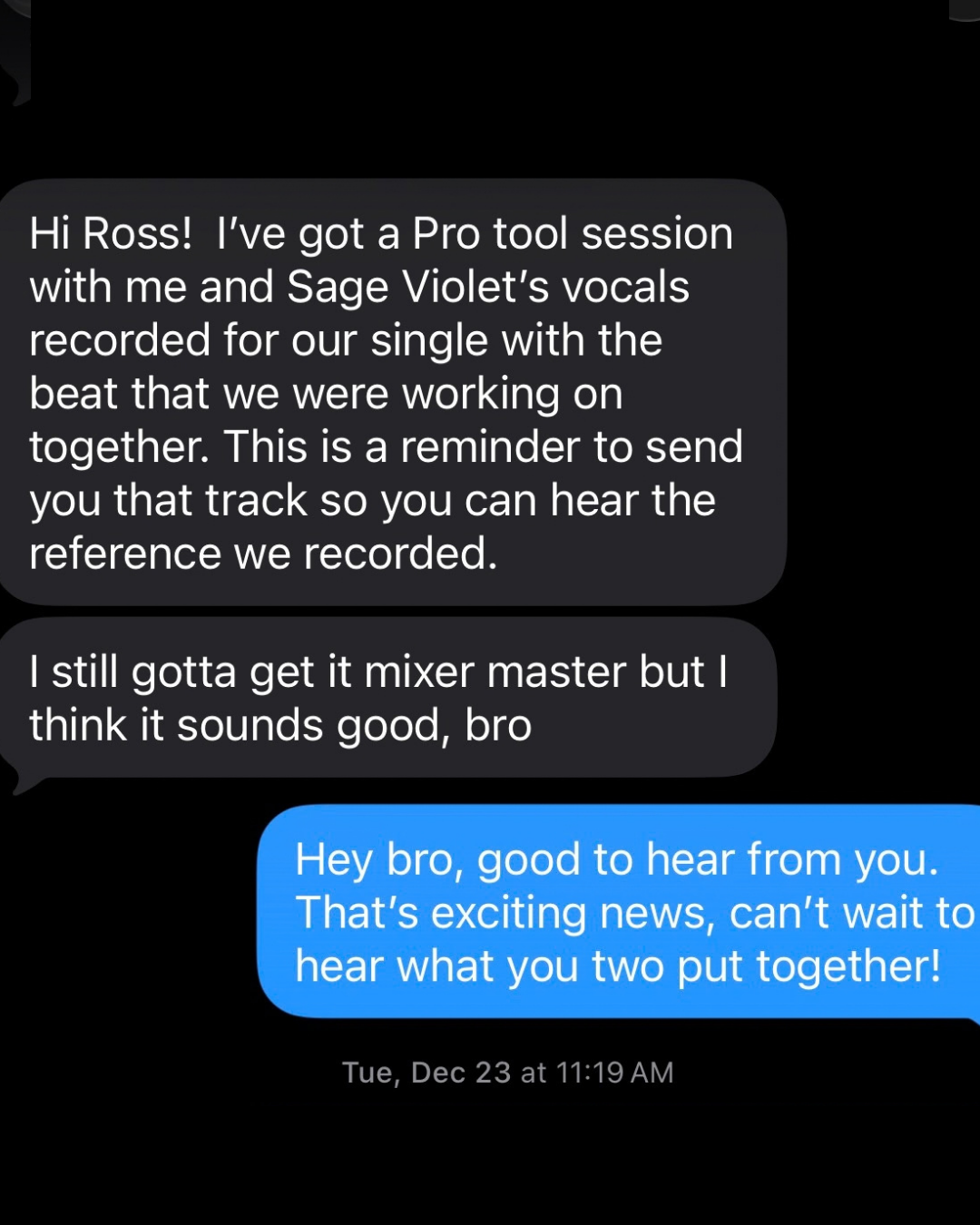
The impact of school, with its constant grind, was clearly hyper-present as Niko worked on his lyrics. During this time the two of us would have occasional check ins about life, music, and work. The track often took a back seat, waiting for time and opportunity to finish the lyrics and record them. In the Winter of 2025 Niko sent me a demo that included his vocals. Niko brought in Sage Violet, a multidisciplinary artist he'd met in school, to sing the hook.
At this point the track had evolved from a sample based beat into a fully visualized song featuring contribution from three different artists across two different states.
Completion
The final stage of this multi-year project was the mixing and mastering. At this stage, I brought in Ryan Bannigan for that process. Previously, I had recorded for his project +Ultra, on the track “Metropolis”, and knew he had the technical skills to finish this song. His background as a performer, composer, and producer made him a natural fit.
After receiving all the files Ryan began to mix the track. His contributions went beyond simple technical mixing and mastering tasks like getting the drums to "hit" in the mix, and balancing the vocals. He also made more creative arrangement choices: keeping my original drums in the intro, bringing in Niko's rework for the first hook, and reintroducing a percussive sample from my original version briefly in the outro.
Those ideas were added based on experience and creative intuition, and added something that clearly improved the track. That outcome highlights why I wanted to work with him for this project, not just for the confidence that the track would be mixed professionally, but for his willingness to bring creative ideas without being told to.
As an experienced musician I have been in this position many times, and often found my education insufficient in navigating those scenarios. Over time and through experience I developed systems and mindsets to approach making music with confidence, patience, and flexibility. My goal as an educator is to create a learning environment that better prepares my students for these situations.
No Director, In Practice
The Groove Lab curriculum I’ve developed is an organized system built from my experience to empower my students in making musical decisions outside the classroom.
That's exactly the position I was in writing "Smell The Flowers" no director, just Niko, Ryan, and me making musical decisions in real time. Each participant was open to feedback, and could follow direction if needed, but ultimately they were involved because they knew how to navigate those decisions independently.
Groove Lab is the system I built to teach bassists how to make those decisions in real world music situations when no one else was going to give that direction.
"Smell The Flowers" is out now. Listen to the finished song [here].