
How To Find Notes On The Bass Guitar
Finding the right note on a string instrument can be difficult for one reason, the same note exists on the instrument in more than one location. If you’ve ever known which note to play but not sure where to find it on the bass guitar this lesson is for you. Use this lesson as a guide for learning and eventually memorizing the location of any note on the fretboard. Also, if you’re using a Groove Lab Study to write your own bass line this lesson will help you find the nearest location of any note you’ve selected.
Use this lesson after completing your work from the How To Read Chord Charts Bass lesson.
Why Are There Dots On The Frets Of My Bass?
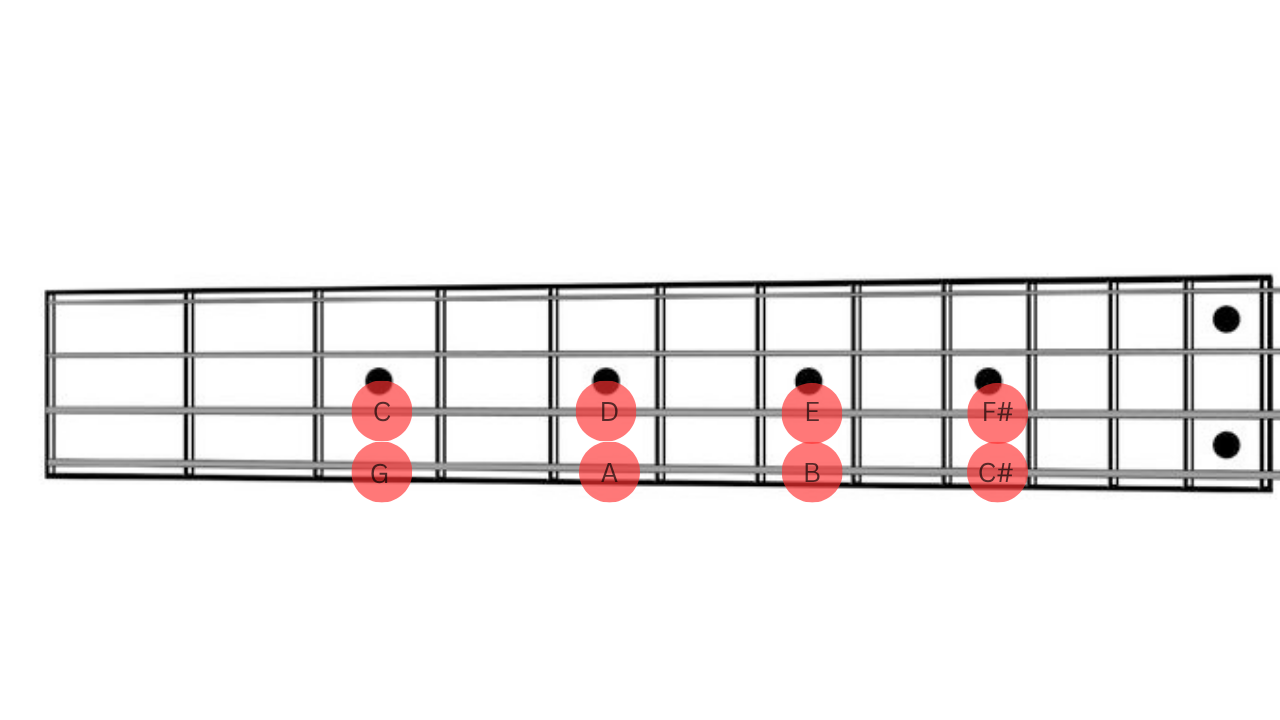
Years ago a student asked this question in the middle of a lesson. At first the answer seemed to be for visually navigating the fretboard at a glance. However, the more I considered the question I noticed something interesting. The first dot on the A string was C, and the first dot on the E string was G. Then the second dot lined up with D on the A string, and A on the E string. Each dot corresponded to a note from the cycle of fifths: C, G, D, A, E, B, F#, C#. This discovery made me curious and I eventually concluded that those dots could be used to create visual cues based on the cycle of fifths. Since then I’ve used that system in lessons to develop a foundational relationship with note locations on the instrument.
Practice As A Drill
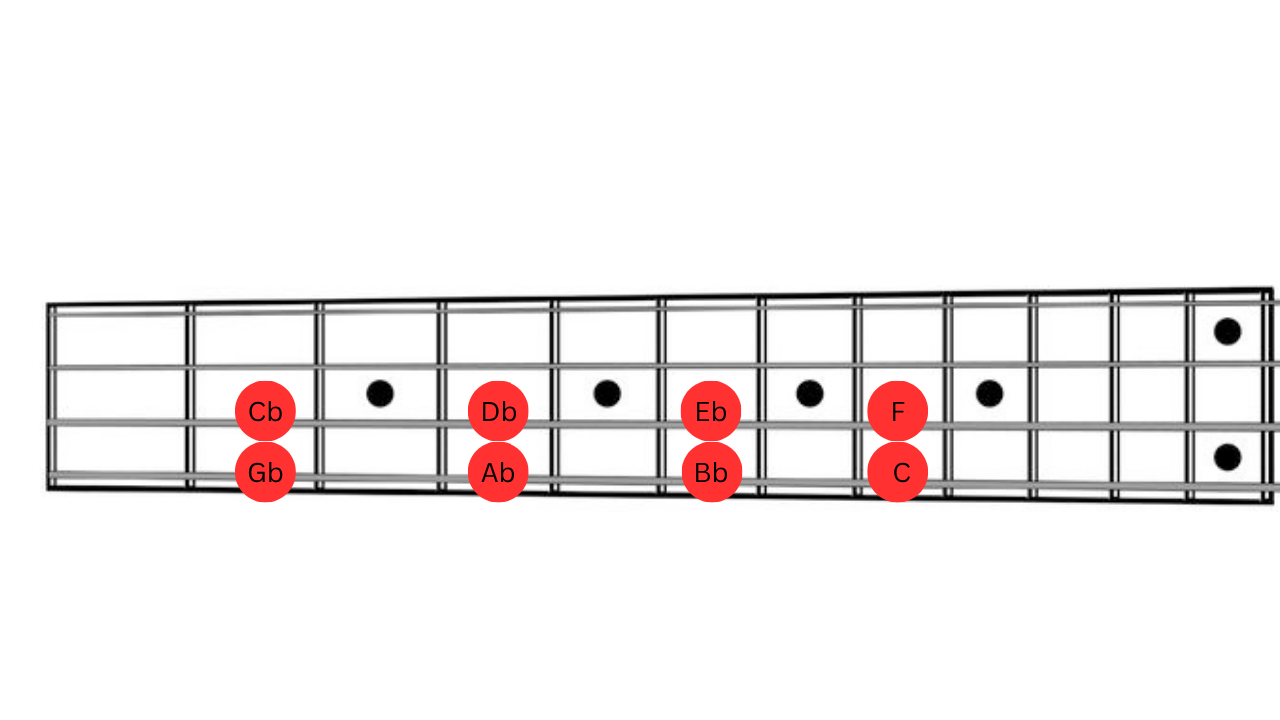
Practice playing the notes and naming them in order from C-G-D-A-E-B-F#-C# up then down. Be sure to move your hand only once after playing A and before playing E. Use this video for guidance and practice slowly reading the note names from the diagram above as you play.
Finding Notes On The Bass
Using the previous diagrams, you can find at least one location of every note on the E and A strings between frets 2 and 9. As a guiding principle, use the lowest version of a note whenever possible, which is why the diagrams only show the E and A strings.
A solid understanding of intervals will allow you to identify these same notes on other strings and in other locations, for more help download the Interval Worksheet.
After completing this lesson move on to the Voice Leading For Bass lesson.
Your Next Step
Groove Lab Study’s are free guided studies built around custom backing tracks. This lesson is Step Five: finding the location of the notes used in the harmony on the bass guitar. After completion submit your note selection diagram to your teacher.
Step Six is using voice leading to make smooth transitions between chords, use the Voice Leading lesson to complete. After completion submit your voice leading diagram to your teacher.