How to Learn Songs on Bass: Why Great Musicians Use More Than One Method
What's the best way to learn songs on bass? Should you use bass tabs, tutorials, chord charts, or learn by ear?
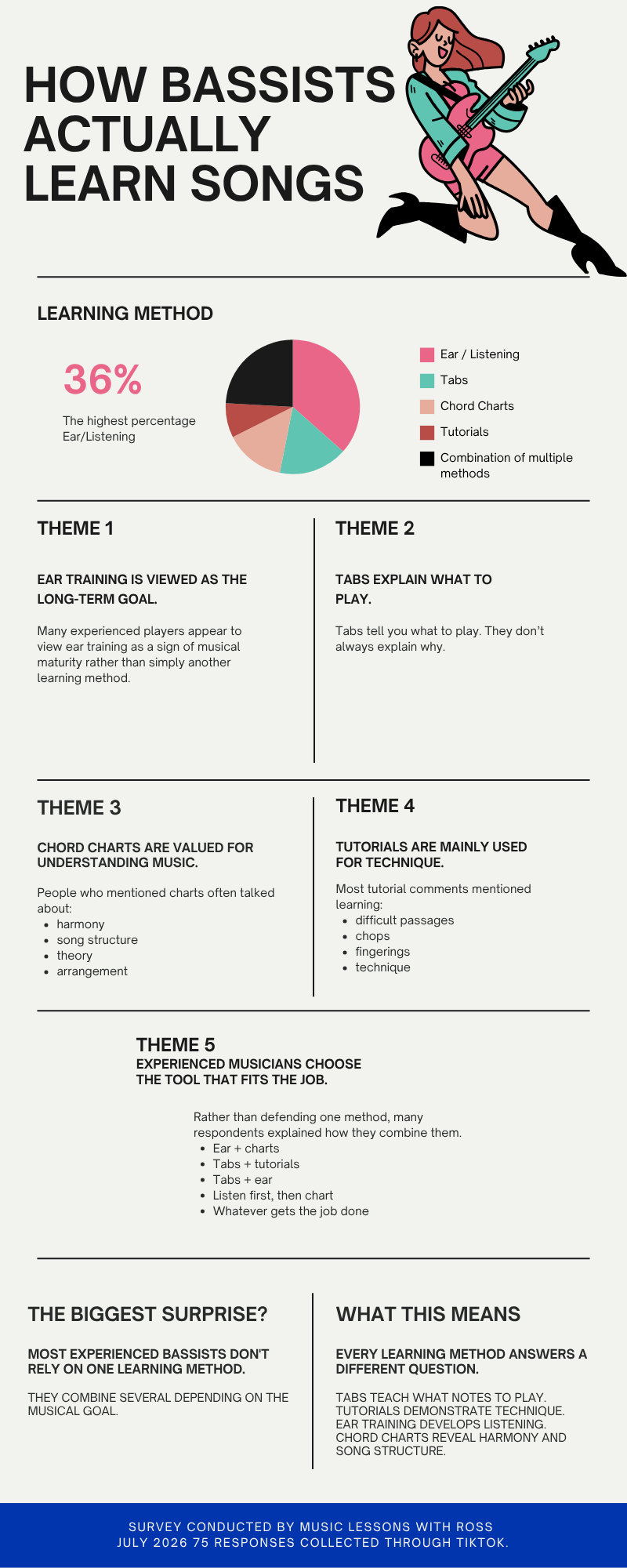
I recently asked over 100 bassists that exact question on TikTok. I expected one learning method to clearly stand above the rest.
Instead, the responses revealed something much more interesting.
Many of the most experienced musicians didn't choose a single method at all. They described combining tabs, ear training, tutorials, and chord charts depending on the musical skill they were trying to develop.
That shifted the question entirely. The real issue isn't Which learning method is best? It's Which learning method is best for the skill you're trying to build?
The more I mature as a musician, composer, and educator, the more convinced I become that every notation system is an incomplete representation of music. Tabs, tutorials, chord charts, and ear training each reveal a different part of the picture. Great musicians learn to combine those perspectives—and eventually move beyond simply recreating music toward understanding the musical decisions behind it.
The Four Ways Bassists Learn Songs
1. Bass Tabs
Bass tabs are often the first notation system players encounter, and for good reason. They make learning songs approachable by showing exactly where to place your fingers on the instrument. For beginners especially, tabs remove much of the mystery surrounding the fretboard and make it possible to start playing recognizable music quickly.
Tabs are particularly effective for learning note selection and fretboard navigation. If your goal is to memorize a bass line or build technical vocabulary, they're one of the fastest and most accessible tools available.
Like every learning method, however, tabs communicate some types of information better than others.
Most tabs place little emphasis on rhythm, harmony, or the musical reasoning behind a bass line. While they tell you whatnotes to play, they rarely explain why those notes were chosen, how they relate to the underlying harmony, or how they should feel rhythmically within the groove.
Because of this, many players become comfortable reproducing bass lines without fully understanding how those lines function in the music. They may know where to put their fingers, but struggle to recreate the groove, adapt the idea to another song, or write something similar themselves.
Tabs are an excellent tool for building musical vocabulary.
But vocabulary alone doesn't create musicianship.
To become a complete musician, tabs are most effective when paired with listening, rhythmic understanding, and harmonic analysis.
If you're ready to move beyond memorizing notes and begin understanding why bass lines work, explore Groove Vocabulary for Bass Players, where we break down the musical concepts behind groove, pocket, placement, and feel.
2. Tutorials
Video tutorials have become one of the most accessible ways to learn bass. YouTube and social media are filled with performers and educators demonstrating everything from famous bass lines to advanced techniques, making it easier than ever to watch experienced musicians solve musical problems in real time.
Tutorials are particularly valuable for learning technique, body mechanics, and physical execution. Seeing how a player positions their hands, attacks the strings, or shifts across the fretboard can communicate details that written notation simply cannot. For many bassists, this visual feedback can save hours of frustration and accelerate technical development.
Technical control only becomes musical when it serves the groove. Continue with 3 Bass Technique Exercises That Instantly Improve Your Groove to develop consistent articulation, dynamics, and control.
Like every learning method, however, tutorials emphasize certain types of learning more than others.
Many tutorials focus on what to play and how to play it, but spend less time exploring why those musical choices work. It's common to learn a riff accurately without discussing how the groove supports the drums, why certain notes were chosen over others, or how the idea could be adapted in a different musical context.
Tutorials are excellent for developing technical confidence and observing experienced musicians.
They become even more valuable when paired with analysis that explains the musical decisions behind the performance.
3. Chord Charts
Chord charts provide a different type of information than tabs or tutorials. Rather than prescribing exactly what to play, they outline the harmonic framework of a song and leave the performer responsible for creating their own part.
Because chord charts are useful for every instrument, they're widely available and often easier to find than instrument-specific transcriptions. They encourage experimentation, improvisation, and personal interpretation instead of memorizing a single "correct" bass line.
For bass players, chord charts are especially valuable because they develop harmonic awareness. Instead of asking, "What notes did someone else play?" the question becomes, "What notes best support this harmony?" That shift moves the player from reproducing music toward creating it.
The tradeoff is that chord charts assume a greater understanding of harmony. Players who are unfamiliar with scales, chord tones, voice leading, or harmonic function may find them intimidating at first. They also provide very little information about rhythm, groove, articulation, or note placement, leaving those decisions entirely to the performer.
Chord charts are one of the strongest tools for developing musical independence.
To make chord charts more useful, develop your understanding of harmonic function and smooth bass line construction in Voice Leading: How to Create Smooth Transitions Between Chords on Bass.
They become most effective when paired with listening, rhythmic analysis, and a solid understanding of harmonic relationships.
4. Learning By Ear
Learning music by ear is one of the oldest traditions in music. Long before notation systems existed, musicians learned by listening, imitating, and responding to one another. While modern technology has given us countless ways to learn songs, developing your ear remains one of the most valuable skills a musician can build.
Learning by ear develops something the other methods cannot: active listening. Instead of relying on written instructions, you're training yourself to recognize rhythm, harmony, melody, articulation, and feel directly from the music. Over time, this strengthens your musical intuition and builds confidence in your ability to solve musical problems independently.
Learning by ear also changes your relationship with music. Listening becomes an active process of asking questions, identifying patterns, and making musical decisions rather than simply consuming what you hear.
Like every learning method, however, it comes with challenges.
Learning by ear can feel slow and frustrating, especially for players who are accustomed to having every note written out. It requires patience, repetition, and realistic expectations. Even experienced musicians regularly slow recordings down, isolate difficult passages, and revisit phrases multiple times before they feel confident in what they're hearing.
Rather than viewing these challenges as signs of failure, think of them as part of the training process. Every phrase you learn by ear strengthens the listening skills that support improvisation, composition, ensemble playing, and musical independence.
Learning by ear becomes much easier when you know what to listen for. Groove Vocabulary for Bass Players provides a framework for identifying pulse, subdivision, placement, note duration, dynamics, and space while listening.
Learning by ear doesn't replace tabs, tutorials, or chord charts.
It helps you become less dependent on them.
Becoming Your Own Musical Detective
After asking more than 100 bassists how they prefer to learn songs, I expected to discover one method that clearly stood above the rest.
Instead, I found something much more valuable.
Every learning method answers different musical questions.
Tabs answer where to play.
Tutorials demonstrate how to move.
Chord charts explain what harmony you're supporting.
Learning by ear develops how you listen.
None of them tell the entire story.
Every resource is a snapshot of the music.
Groove Lab is built around this idea. Every lesson, study, and worksheet explores the same piece of music from multiple perspectives so you gradually learn to connect the information yourself.
Each captures one perspective while leaving other parts for the musician to discover.
A tab may accurately show every note while saying very little about harmony or feel.
A chord chart explains harmonic movement but leaves rhythmic phrasing and articulation open to interpretation.
A tutorial reveals the physical mechanics of a technique but may spend little time discussing why those musical choices work.
Even learning by ear has limitations. What you hear is shaped by your current technical ability, harmonic understanding, and listening experience.
As musicians grow, something interesting begins to happen.
Instead of expecting every resource to provide every answer, they begin filling in the missing information themselves.
They hear the groove behind the tab.
They recognize harmonic movement hidden within the chord chart.
They understand the musical purpose behind a technique demonstrated in a tutorial.
They use their ear to verify, question, and refine what every other resource suggests.
That is where musicianship begins.
The goal isn't to find the one perfect learning method.
The goal is to develop enough listening, technical, and harmonic understanding that every resource becomes more valuable than it was before.
A beginner reading a chord chart and an experienced musician reading the exact same chart aren't seeing the same thing.
The information hasn't changed.
The musician has.
Great musicians become musical detectives.
When they encounter an unfamiliar groove, technique, or harmonic idea, they don't ask,
"What's the correct way to learn this?"
Instead they ask,
"What information is this resource giving me, and what do I need to discover for myself?"
That question changes everything.
Rather than depending on one method, they combine listening, analysis, experimentation, and experience until the complete musical picture begins to emerge.
That's ultimately what Groove Lab is designed to develop.
Not musicians who simply recreate bass lines.
Musicians who know how to observe, analyze, experiment, and make thoughtful musical decisions wherever they find themselves.
Subscribers receive:
Original compositions
Bass tabs
Practice worksheets
Musical analysis
New Groove Lab lessons
If you're interested in understanding **why music works—not just what to play—join the newsletter.