
Navigating the fretboard of the bass is an important skill to develop. One way to build that skill is to use scales and arpeggios, which help develop fluency across the instrument. The following drill was arranged for four-string bass from a six-string exercise demonstrated by Henrik Linder. It blends the C major scale and its diatonic 7th chords to navigate a two-octave range and all four strings.
Who It's For
Intermediate bass players who want to turn scale knowledge into a working map of chord tones.
Before You Start
You should already:
know the C major scale
know the diatonic 7th chords of C major (CMaj7, DMin7, EMin7, FMaj7, G7, AMin7, BMin7♭5)
be comfortable playing across all four strings without strain or tension
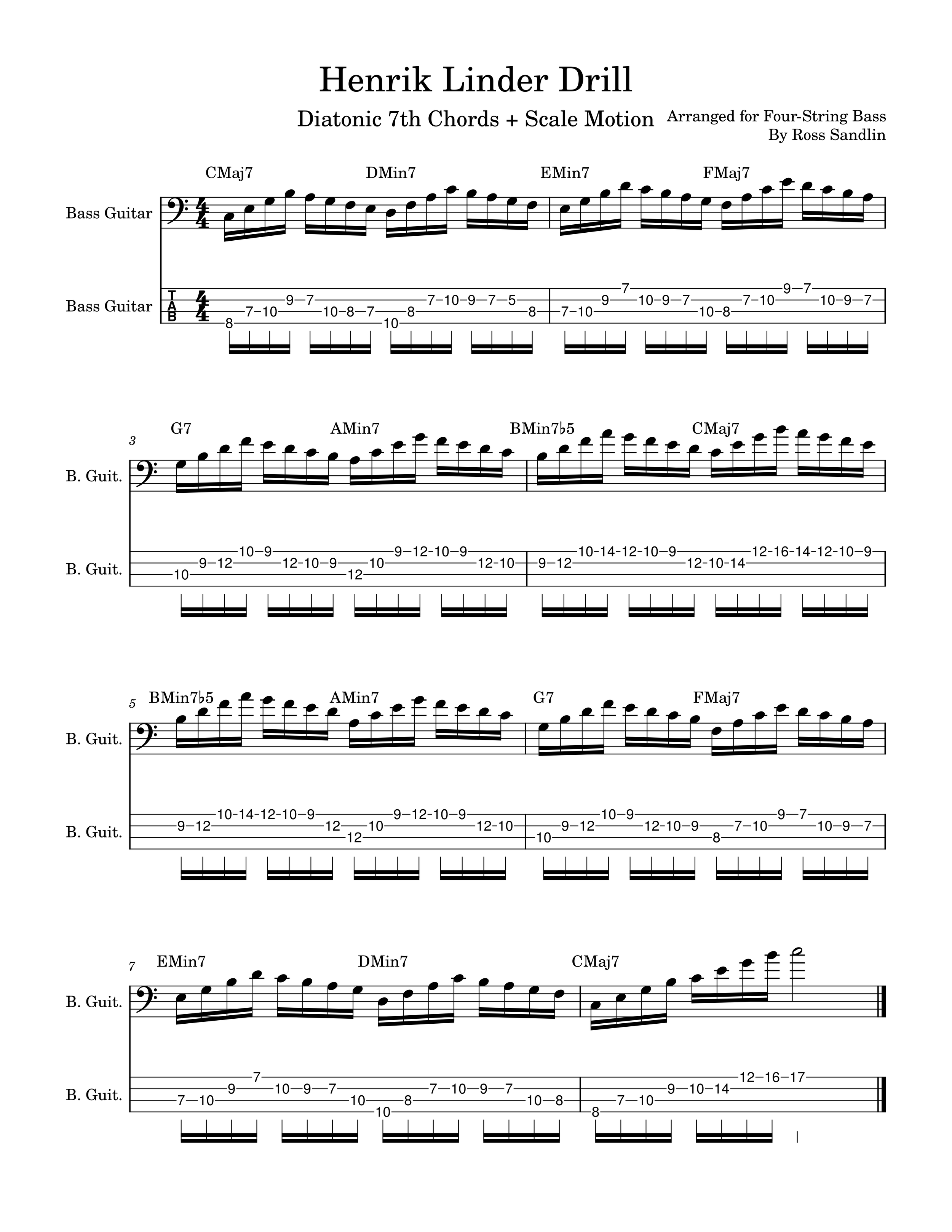
Henrik Linder Drill, arranged for four-string bass by Ross Sandlin. Download the full PDF below.
Explaining the Sequence
On beats 1 and 3 of each measure you play a 7th-chord arpeggio. On beats 2 and 4 you play descending stepwise scale motion that leads to the next chord. The drill uses the following sequence of arpeggios and scale degrees:
CMaj7 ascending: C E G B
Scale degrees 6 5 4 3 descending: A G F E
DMin7 ascending: D F A C
Scale degrees 7 6 5 4 descending: B A G F
EMin7 ascending: E G B D
Scale degrees 8 7 6 5 descending: C B A G
FMaj7 ascending: F A C E
Scale degrees 2 8 7 6 descending: D C B A
G7 ascending: G B D F
Scale degrees 3 2 8 7 descending: E D C B
AMin7 ascending: A C E G
Scale degrees 4 3 2 8 descending: F E D C
Bm7♭5 ascending: B D F A
Scale degrees 5 4 3 2 descending: G F E D
CMaj7 ascending: C E G B
That brings you to the top of the pattern. From there, the second half of the drill (measures 5 through 7) plays the same arpeggio-and-scale pairs in reverse chord order: Bm7♭5, Am7, G7, Fmaj7, Em7, Dm7. The drill finishes on one last Cmaj7 arpeggio and a rising scale run.
Navigating the Fretboard
The goal is to change hand positions only when necessary. Cmaj7, Dm7, Em7, Fmaj7, and G7 can each be played from a single hand position, so assign one finger per fret for this portion of the exercise. Am7, Bm7♭5, and the second Cmaj7 require moving hand positions. Measures four and five are the hardest part of the drill, so give them extra attention.
Bm7♭5 and the second Cmaj7 arpeggio use a two-string pattern, whereas all the others use a three-string pattern. For those two arpeggios, use your index finger for the root, pinky for the third, index for the fifth, and pinky for the seventh.
Get the Exercise
Download the free four-string bass arrangement Technique Drills 01 and use it as your practice reference.
How to Practice This Exercise
Start slow. Begin at 60 BPM and increase by 5 BPM at a time until you can play the drill at 100 BPM or faster.
Prioritize clean playing. Aim for even sixteenth notes and smooth, accurate transitions, especially in measures four and five.
Change keys. Once you can play it at 100 BPM, move the whole pattern down a whole step to B♭ (the first arpeggio starts at fret 6), then up a whole step to D (fret 10). The shapes stay the same, so this shows whether you know the pattern or have only memorized the positions in C. Playing it in D takes you up to about fret 19, so you'll need a bass with at least that many frets.
Record yourself. Watch your video once for each question:
Notes: does every chord tone match the score?
Timing: are the sixteenths even, especially after hand-position changes?
Articulation: do the arpeggios and scale runs sound equally clear and even in length?
Ready to write your own bass lines? Learn how in Groove Lab Study 4.