

Peter, an advanced student, was asked to write a hip hop bass line using the Groove Lab Study 3 backing track and study guide. He followed step-by-step instructions that included making a rhythm road map, placing bass notes within the pocket, analyzing chords, using voice leading to build a bass line that was further refined through the Practice Cycle. This piece walks through each stage from the first rhythm road map to the final performance, with my notes on what worked and what comes next.
What Is GLS3, and What Problem Does It Solve?
Many bass players first learn to play through copying existing songs and riffs. This approach teaches you how to play a song correctly, but doesn’t teach why those ideas work. Often, players struggle to translate what they learn from tabs or tutorials into their own playing vocabulary. The result is that when it’s time to create something new, they freeze.
Groove Lab Studies are built to close that gap. Each one is a guided, step-by-step lesson on writing your own bass line, using a custom backing track instead of tabs. GLS3 uses a jazz fusion and hip hop influenced beat and introduces two core ideas: rhythm mapping and voice leading. Each study stands on its own, and it’s free.
The goal isn’t one right answer. Each student writes their own idea, and multiple answers can be correct, which leaves room for individual interpretation and expression. It also shows where a student is struggling, so they can get focused support. Students submit their work to me for feedback, and Peter’s submission shows what that process looks like at an advanced level. The steps are the same at any level. Only the depth of detail changes.
Download the GLS3 study guide and follow along with the same backing track.
The Performance
Here is Peter’s finished bass line over the GLS3 backing track, recorded live into Ableton at my studio in Stone Mountain.
Step 1: Rhythm Road Map
Every GLS starts with the drums. Success in this step is determined by completion and accuracy. Here we see that Peter mapped the kick and snare drums in each measure. This step is important because it creates a visual rhythmic framework used to make decisions in later steps.
A rhythm road map is a grid that marks where the kick and snare land in every measure, so you know where your bass line fits. For more on this, see my lesson on locking in with the drums.
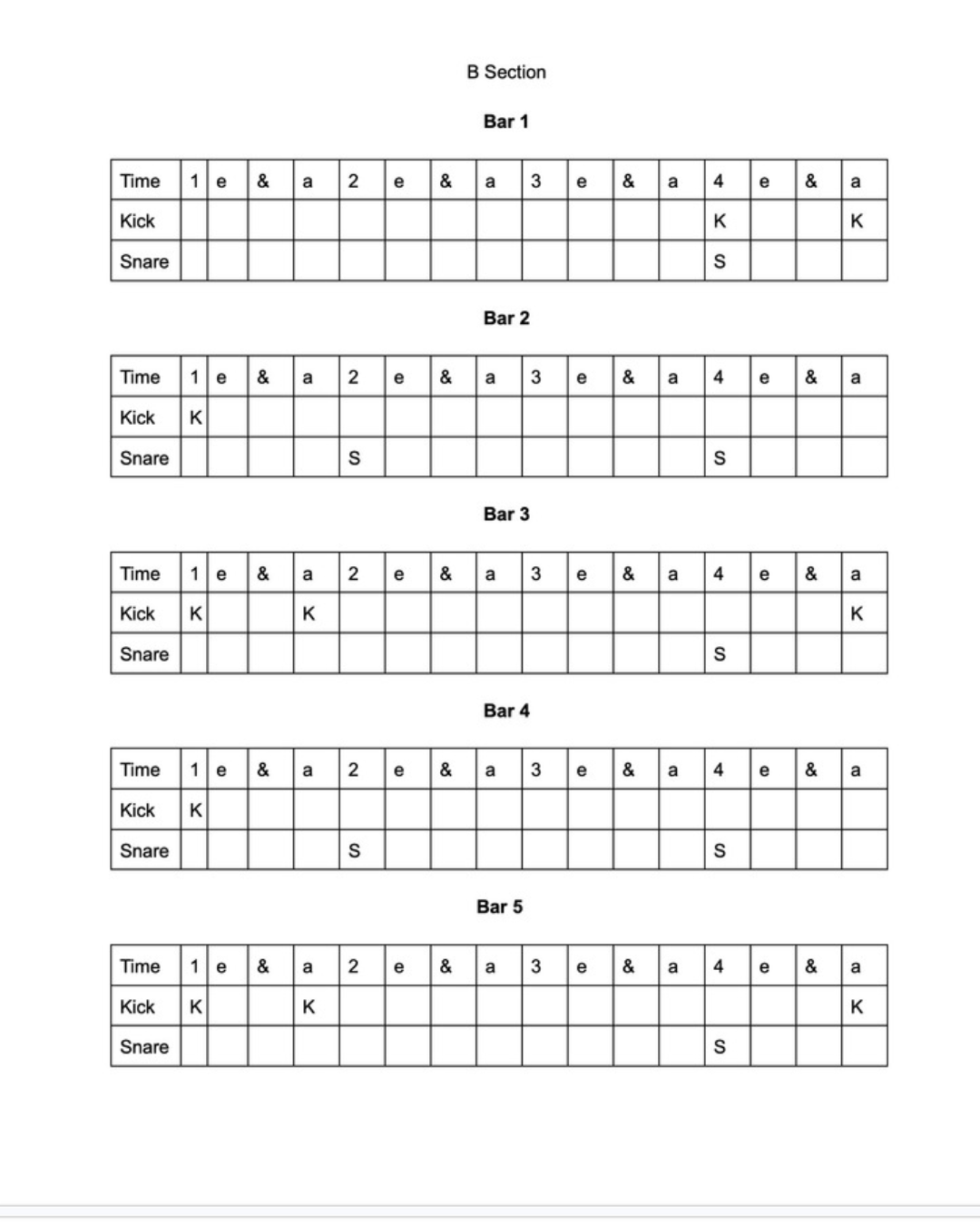
Rhythm road map showing kick and snare placement across the GLS3 backing track, completed by Peter.
What I noticed in Peter’s Rhythm Road Map is its accuracy and thoroughness.
The “B” section of the track uses a common hip hop arrangement: the drums drop out entirely, then return as a pickup. Peter correctly identified the empty space and the kick and snare hitting together on beat 4. He also correctly identified that the snare drops out on beat 2 in measures 3 and 5. He mapped the entire B section, although the assignment required only four measures.
Peter’s map meets both criteria, completion and accuracy, and goes further by covering the entire B section when only four measures were required.
Step 2: Chord Analysis
After analyzing the rhythm, the next priority is correctly identifying and analyzing the harmony of the backing track. Here success is determined by correctly identifying the chords and the notes they contain. This step is important because it creates a list of appropriate or “correct” notes that can be used.
Chord analysis means naming each chord in the track and listing its notes, which gives you a pool of notes that fit the harmony. New to chord charts? Start with how to read chord charts for bass.
Voice leading means choosing notes that move smoothly from one chord to the next, often by just a half step.
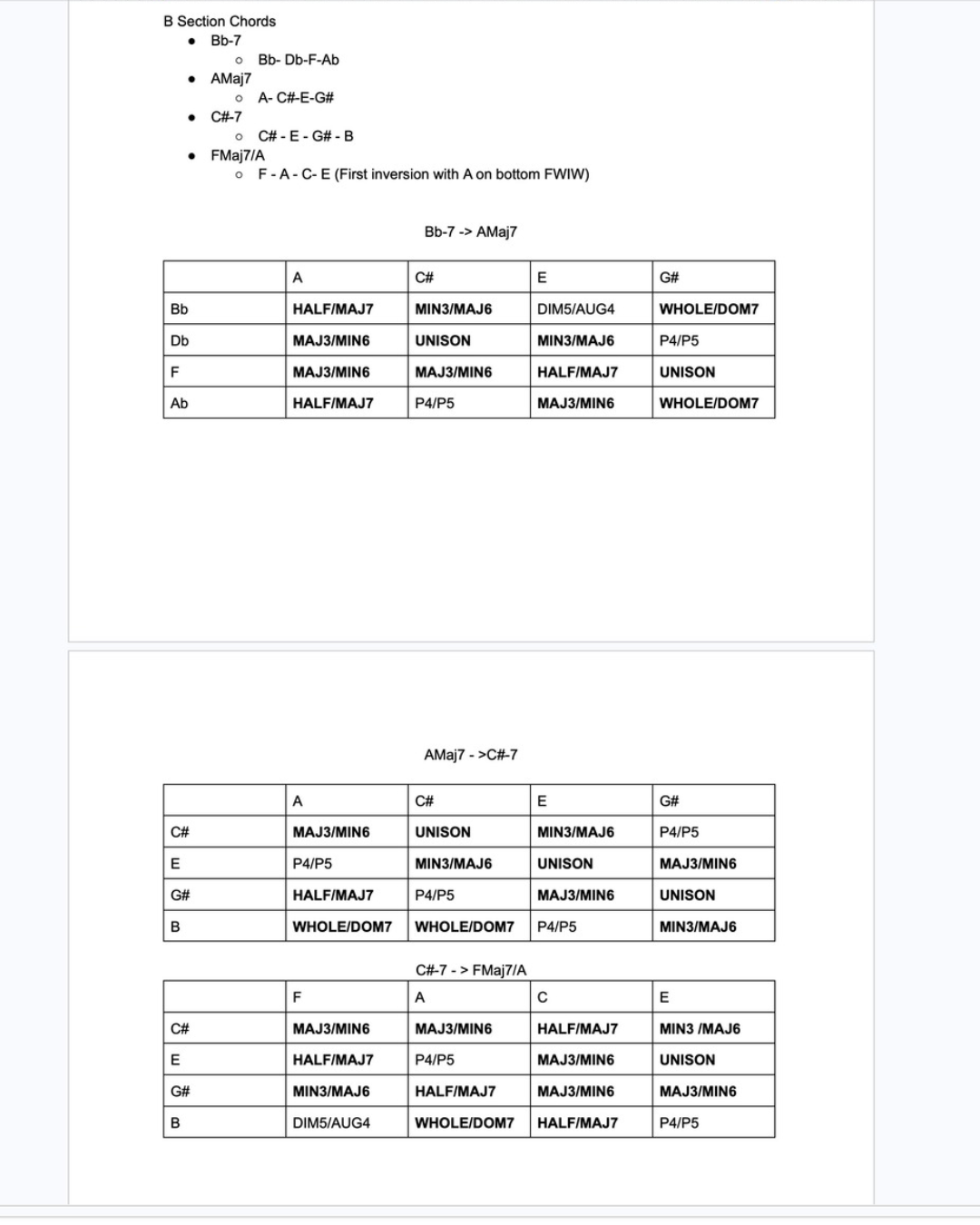
Chord analysis of the GLS3 backing track showing chord names and chord tones, completed by Peter.
What I noticed in Peter’s harmonic analysis is continued accuracy and detail.
Each chord is correctly identified and its notes are documented, including extensions and inversions. He then documents the intervallic relationships between the notes of each neighboring chord.
One change or addition that would have improved his submission is to identify the intervallic relationships between Fmaj7/A and Bb-7. This would help ensure that the end of the progression loops back to the beginning smoothly.
Peter met the criteria for this step: every chord is correctly identified and its notes are documented.
Step 3: How Peter Combined Rhythm and Harmony
With the rhythm map and chord analysis done, Peter built the bass line itself, combining rhythmic choices that sit with the drums and note choices that connect the chords.
Success here means a bass line that locks in with the drums and uses notes from the chord analysis, with smooth voice leading between chords.
Peter’s practice take, recorded during the Practice Cycle
You can hear the intentional space, in bars two through four, left for the snare. This carves out a rhythmic space where the snare cuts through and creates a strong back beat.
Also, the use of half-step motion between the Bb minor chord and the A major chord in bars one and two correctly applies voice leading and creates tension and release between the chord changes.
Peter met the criteria for this step by creating a bass line that locks in rhythmically with the drums, uses notes from the chords, and connects those chords through voice leading.
Step 4: The Practice Cycle
After writing the bass line, Peter worked through the Practice Cycle to identify mistakes, poor habits, or areas of awkwardness. This is a crucial step in the Groove Lab Study, because it helps students identify what they need to work on and gives them a strategy for developing solutions to their issues.
Success here means identifying a specific, limited issue, defining what success looks like for it, and checking your progress.
The Practice Cycle is a routine for finding what to fix: observe your playing, analyze one or two issues, define what success looks like, then reflect on the result. You’ll find it in every Groove Lab Study.
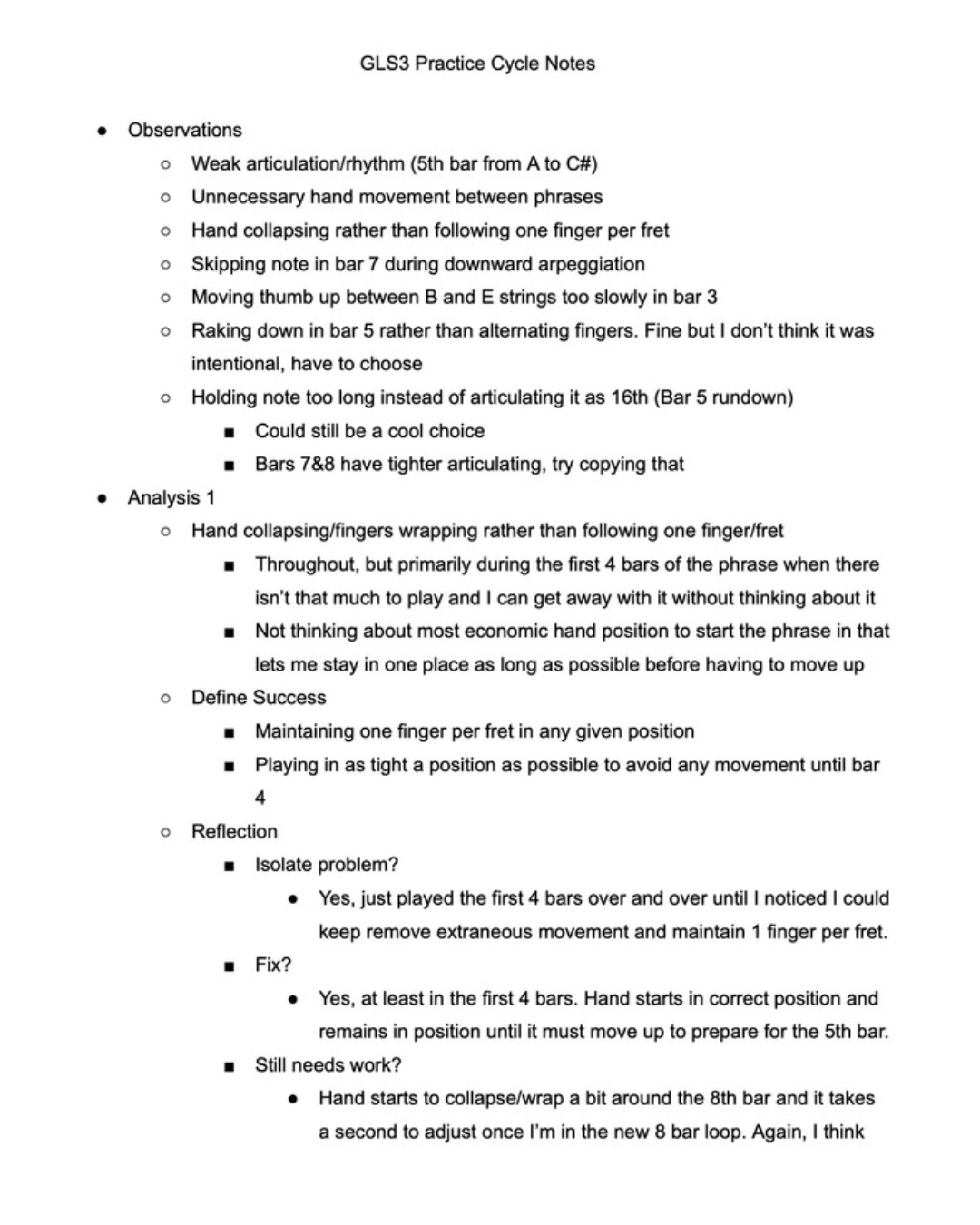
GLS3 Practice Cycle notes by Peter, page 1: observations on articulation and hand movement, then analysis, definition of success, and reflection on keeping one finger per fret.
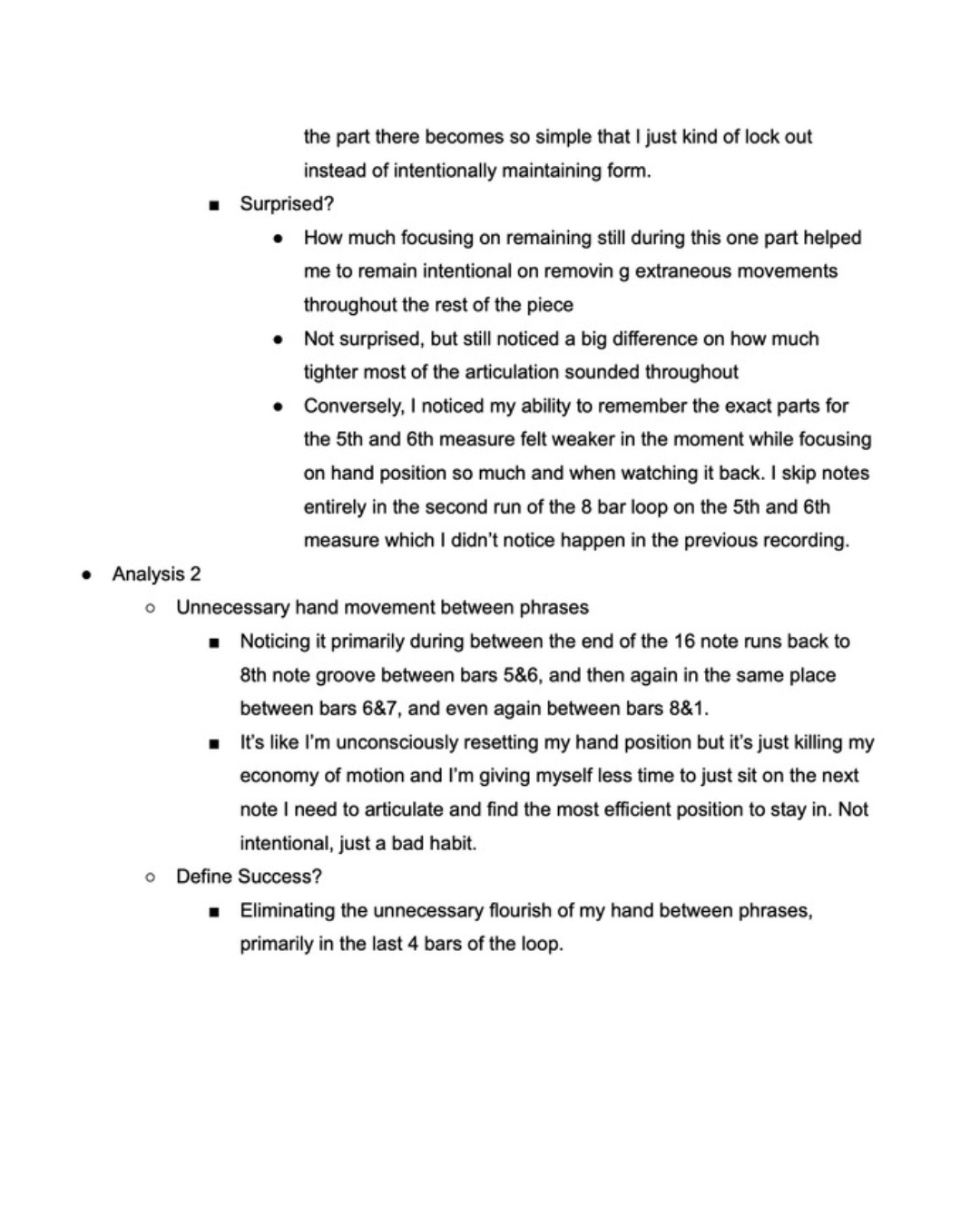
GLS3 Practice Cycle notes by Peter, page 2: surprises, plus analysis and definition of success for eliminating unnecessary hand movement between phrases.
In the observation step, Peter identified several possible areas for improvement, and then moves on to analysis, picking two related issues to address. By choosing a limited area of focus he is able to make small adjustments that will have a meaningful impact on his playing.
Of the issues identified, he chose to work on his hand position and mechanics, noting that success would be achieved by maintaining one finger per fret and by assigning fingers to notes so phrases begin and end with as few position changes as possible.
That limited focus allows for a clear and simple definition of success. With that definition he can create drills that prioritize the issue he has without wasted energy or attention.
In the reflection step, he observed the progress towards success that was achieved, while also holding general curiosity about other issues impacting his execution.
Peter met the criteria of this step by narrowing his focus to two related issues and defining what success looks like for each.
What You Can Take From This
GLS3 is built on a hip hop influenced beat, but the skills it teaches aren’t tied to one genre. They give you a way to start writing your own bass ideas over any song. Here’s what carries over from Peter’s process:
Rhythm road map: reading the drums to decide where to play and where to leave space works over any groove.
Chord analysis: listing the notes in each chord gives you options over any progression.
Voice leading: moving smoothly between chords, like Peter’s half-step motion from Bb minor to A major, applies in any style.
Practice Cycle: choosing one or two issues and defining what success looks like works on any skill, not only bass lines.
These skills translate to your future work and improve with continued use.
Try GLS3 Yourself
The GLS3 study guide and backing track are free. Download it, work through the rhythm map and chord analysis, and write your own line.
Want feedback from me on your bass line? I teach one-on-one hip hop bass lessons in Stone Mountain (Atlanta area) and online. Learn more about lessons.
Now Available: GLS4, a free holiday jazz hip hop study, launched November 1.