
Hip Hop Groove on Bass Pt. 2: Harmonic Function, Dilla Time & Jazz Harmony
Most players approach Dilla-inspired groove as a rhythmic concept, but that’s only half the picture.
The bass lines that define artists like J Dilla and Nujabes don’t just sit in the pocket, they define harmony inside a laid-back, elastic feel.
👉 That’s what separates:
“looping over a beat”
vs.“playing music that feels intentional”
In Part 1, we focused on time and feel.
In Part 2, we’re focusing on harmonic function within that feel.For more direction on groove and harmony review our guide.
What is “Harmonic Function” on Bass?
1. Foundation: Outlining triads
Defines the chord while locking in with the drums.
2. Direction: Voice leading
Connects chords smoothly through use of common tones, neighboring tones, and leading tones.
3. Color: Extensions
Extensions are the notes in a chord beyond the initial triad, this includes 7ths, 9ths, 11ths, and 13ths.
They are defining characteristic of Jazz shared with Hip Hop to reinforce emotion.
👉 Key insight:
In lo-fi / Dilla-style music, you’re grounding the harmony of the samples, and connecting them to the drum groove.
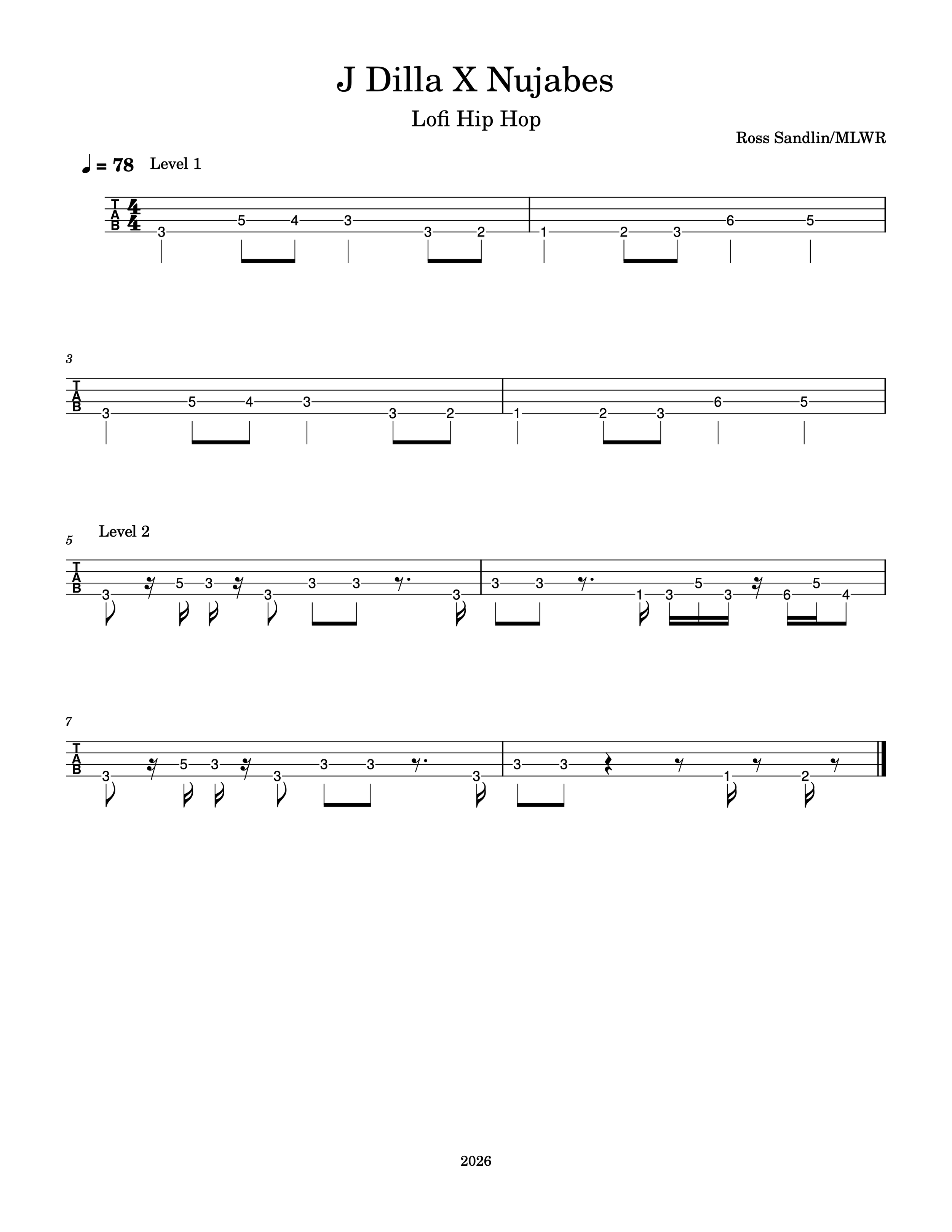
Harmonic Function Analysis:
Bass Arrangement Level 1
In the first measure we start with the root and fifth of G minor, when the harmony changes to F minor we look to see what notes from that chord are nearest in interval to the D of G minor. The fifth of F minor, C, is a whole step away. Using the concept of Voice Leading, we connect the D and C with a leading tone C#/Db. This use of chromaticism builds and releases tension in a pleasant way that is common in both Jazz and Hip Hop Harmony.
The F minor chord has been established, but in order to create motion we want to use similar leading tone motion to the root. It is also important that we maintain the rhythmic motif previously established, this gives us two 1/8 notes to use in our approach to the root. Using the note G allows use to move by half steps first to F#/Gb, then land on our target note of F. The G is not part of the triad of F minor, however, in the context of the chord it is functioning as the 9th, an extension or color tone.
In measure two of the arrangement, the harmony is still in F minor, but is going to switch to a Bb7 chord. To create motion that anticipates this chord change we invert the last phrase by playing F#/Gb to G moving towards the target note Eb. This note is not part of the Bb7 chord, but functions as an 11th another extension or chord tone. This note is followed by D, which is a common tone in both Bb7 and the G minor we are resolving to. It is a strong choice due to being a common tone between chords, and because it is a half step below our last note.
Harmonic Function Analysis:
Bass Arrangement Level 2
In the first measure we start with G and D again outlining the G minor, but we no longer use a leading tone to connect D to the C of F minor. Instead, we use whole step motion then immediately proceed to G and then return to C for two 1/8 notes. This phrase of G followed by two C’s is a repeated motif also used in measure two, again making use of the extension or color tone of a 9th within the F minor chord.
The practice of repeating motifs displaced across different beats and measures is a commonly used technique in J Dilla’s production. Check out our arrangement of E=MC2 for another demonstration of this idea.
Measure two ends with a syncopated phrase that starts with F, G, D, G, which makes further use of the 9th while adding the extension of a 13th. The use of which is commonly associated with Jazz pianists to add color and tension without changing the underlying triad. The end of measure two uses Bb, D, and Ab, which are all chord tones of the Bb7. Their use functions to outline the chord while using voice leading, because the Ab resolves down a half step to G in measure three.
Measure three repeats measure one, and the first two beats of measure four repeat measure two. On beats three and four of measure four we get a syncopated chromaticism from the F back to G, that functions as the fifth of the Bb7 followed by a leading tone resolving to the root of the G minor.
Practice Framework
When analyzing the harmonic function of a bass line, start with identifying triad chord tones. This allows you to understand how many notes are there to outline the chord.
Anything used that isn’t part of those chord tones is functioning as either a) and extension, or b) some sort of leading tone. By dividing notes into one of these three categories it’s much easier to identify how the notes of the bass line are functioning.
Once you’re comfortable identifying the function you can prioritize what the note selection sounds like in emotional terms.
This is a key point in translating bass lines you’ve learned into musical vocabulary you can use in writing your own ideas.