

Groove Lab Study 1:An Original Lo-Fi Bass Study
Beyond the Key Center
When bass players first learn a song, the most common question I hear is:
"What are the right notes?"
It's a reasonable question, but I don't think it's the most useful one.
A better place to start is:
"What will make this groove feel familiar?"
Because great bass lines don't simply connect chords.
They create stability while everything else changes.
Sometimes that's accomplished through repetition. Sometimes it's space, note duration, articulation, or smooth voice leading. The notes matter, but they're only one part of a much larger musical conversation.
This is one of the central ideas behind Groove Lab.
Rather than treating bass playing as a search for the correct scale, Groove Lab approaches bass line construction as a series of intentional musical decisions that balance stability and change.
This study explores that idea through an original Lo-Fi composition built from harmonic colors that move beyond a single key center.
Listen Before We Analyze
Before looking at the notation or thinking about note choices, spend a minute listening to the track on its own.
Resist the urge to immediately identify a key center or search for the "correct" scale. Instead, listen like a producer or arranger.
Ask yourself:
What musical idea already exists?
Now listen a second time with a different set of questions.
Repetition
Is there a rhythmic motif that already defines the track?
How could the bass reinforce that idea without simply copying it?
Space
Which beats already feel full?
Where is there room for the bass to make a statement?
What happens if the bass intentionally leaves important moments open?
Note Duration
Should the bass sustain into the next phrase?
Would a shorter note create more momentum?
How might articulation change the perceived groove?
Musical Function
Is the bass responsible for creating motion?
Supporting harmony?
Reinforcing the drums?
Or simply providing stability?
Listen for familiarity.
Which rhythmic ideas already feel established?
Which ideas would make the listener feel grounded even as the harmony shifts?
There are no wrong answers.
The purpose of this exercise isn't to predict the arrangement you're about to learn.
It's to develop the habit of listening for musical opportunities before searching for notes.
Every bassist will hear something slightly different, and that's exactly the point.
The arrangement in this study represents one possible solution to the musical problem presented by the track.
Harmonic Analysis
By now we've spent time listening for the groove rather than immediately searching for notes.
That order is intentional.
The motif establishes familiarity first. Harmony provides movement second.
This distinction becomes especially important in music like Jazz Hop, Neo Soul, and modern R&B, where chord progressions often prioritize harmonic color over a single, clearly defined key center.
The progression used in this study moves between Bb minor 11, D7, Ab minor 11, and A-7b5. Instead of functioning as a traditional diatonic progression, each chord is selected for its individual character and the tension or release it contributes to the overall sound.
Because of this, asking,
"What scale fits this progression?"
becomes far less useful than asking,
"How can the bass create continuity while the harmony changes?"
That single question completely changes the role of the bassist.
Rather than relying on one parent scale, we begin thinking of each chord as its own harmonic environment while using the motif to maintain a consistent musical identity.
The harmony creates motion.
The motif creates familiarity.
Together, they create groove.
Bass Line Design
Before writing a single note, I established one guiding principle:
Create familiarity while allowing the harmony to change freely.
Every decision in the arrangement supports that idea.
Motif
The same rhythmic phrase appears throughout the piece, giving the listener something recognizable to follow.
Space
Silence allows the drums and harmony to breathe while reinforcing the motif.
Articulation
Legato and staccato phrasing create contrast without changing the rhythmic identity.
Voice Leading
Small melodic movements preserve continuity as the chords move through different harmonic colors.
Voice Leading as Continuity
Once the rhythmic identity of the bass line is established, voice leading becomes the tool that allows the harmony to evolve without losing that identity.
Voice leading is simply the practice of connecting one chord to the next using the shortest and most musical path possible. Instead of making large jumps, we look for notes that naturally resolve into the next harmonic color.
To review or learn more about what voice leading is and how it works on bass, visit the Voice Leading lesson.
In this study the progression moves through:
Bb minor 11
Bb – Db – F – Ab – C – Eb
↓
D7
D – F# – A – C
↓
Ab minor 11
Ab – Cb – Eb – Gb – Bb – Db
↓
A-7b5
A – C – Eb – G
Notice how many relationships are separated by only a half step:
Db → D
Ab → A
Bb → A
G → Gb
These small movements create a feeling of inevitability and smoothness even though the harmony itself is moving in unexpected directions.
More importantly, this voice leading occurs inside an already established motif.
The rhythmic phrase remains familiar while the harmonic response changes from one iteration to the next. The listener isn't required to relearn the groove every measure—they're simply invited to hear the same musical idea expressed through different harmonic colors.
That's the real purpose of voice leading in this arrangement.
It isn't there to demonstrate theory.
It's there to preserve continuity while allowing the harmony to move freely.
Groove Lab Observation
Many bass players begin by searching for the correct scale.
In practice, listeners rarely experience music that way.
They hear repeated ideas, recognizable rhythms, familiar phrasing, and smooth motion long before they identify a key center.
The strongest bass lines aren't created by finding the "right" notes.
They're created by establishing a memorable motif and making harmonic decisions that allow that motif to evolve without losing its identity.
Motif: The Anchor of the Bass Line
Once I understood the harmonic colors available, I stopped thinking about scales and started thinking about identity.
What musical idea would make this bass line recognizable?
The answer became a simple two-bar motif that repeats throughout the entire study.
Rather than creating a new rhythmic phrase every measure, the motif acts as an anchor. As the harmony shifts between minor 11, dominant, and half-diminished colors, the listener is always returning to a familiar rhythmic idea.
That familiarity is what allows the harmony to become more adventurous without feeling disconnected.
Building the Motif
The motif is intentionally simple.
It begins with a clear statement on beat one, leaves generous space through the middle of the measure, and finishes with a short burst of motion leading into the next phrase.
The second measure responds rather than repeats exactly. The opening note is extended into a longer legato phrase before returning to the same balance of space and movement.
The result feels less like two separate measures and more like a musical conversation:
Call
A direct rhythmic statement that establishes the groove.
Response
The same idea expressed with a different sense of motion and harmonic color.
This call-and-response relationship becomes the rhythmic identity of the entire arrangement.
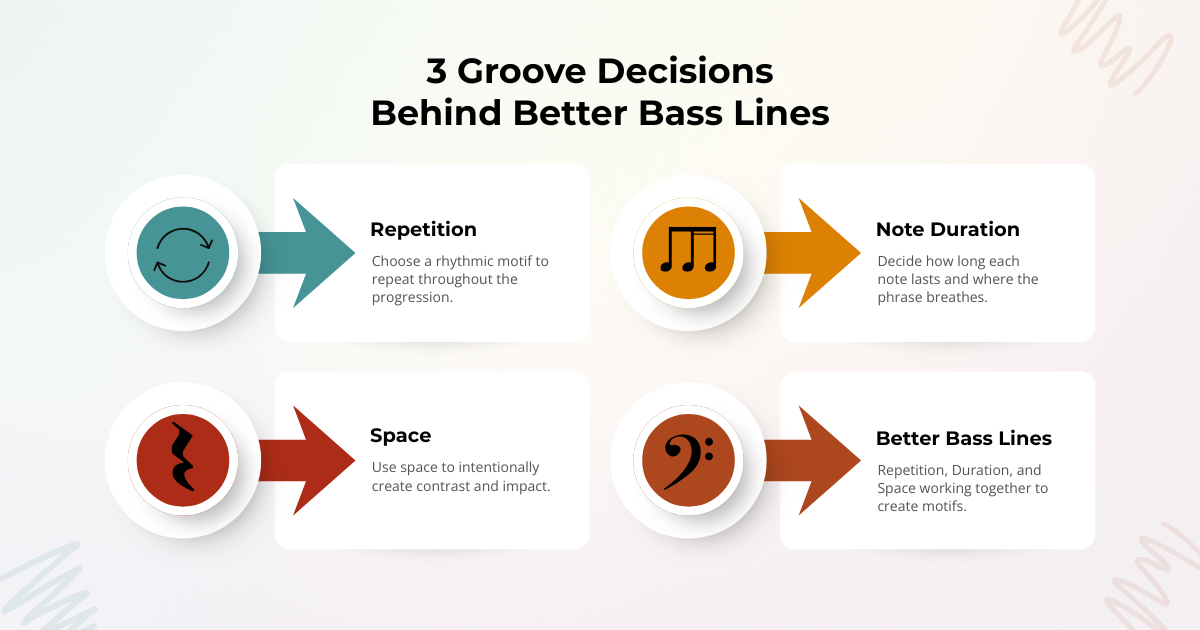
Motif as Musical Decision Making
At first glance, repetition, space, note duration, articulation, and voice leading can seem like separate concepts.
In practice, they are all serving the same purpose.
Repetition makes the motif recognizable.
Space gives the motif clarity and allows the drums and harmony to breathe.
Note duration shapes its momentum, deciding which ideas feel percussive and which feel connected.
Articulation changes its character, alternating between short rhythmic statements and longer legato phrases.
Voice leading allows the motif to move through changing harmonic colors while preserving its identity.
Each decision reinforces the same musical idea instead of competing for attention.
Groove Lab Observation
Many bass players try to create interest by constantly introducing new rhythms or more complex note choices.
This arrangement takes the opposite approach.
The motif remains largely unchanged while the harmony, articulation, and voicing evolve around it.
The listener doesn't remember eight different bass lines.
They remember one familiar idea experienced through different harmonic colors.
That's why motifs are so powerful in Hip Hop, Jazz, Neo Soul, and R&B. They create stability first, making every variation feel intentional rather than random.
Variation Within the Response
If the call establishes the identity of the groove, the response is where the arrangement begins to explore different harmonic possibilities.
Throughout the study, the rhythmic framework remains largely unchanged. The listener continues to hear the same balance of repetition, space, and motion. What changes is how the response outlines the harmony.
Measure 2 — Sliding into the 9
In measure 2, the response begins by sliding from the octave of Ab to the 9 before returning to the octave. This creates a more melodic shape while preserving the identity of the motif. From there, a chromatic phrase connects the root of Ab minor to the root of A-7b5 before resolving naturally to Bb minor in the following measure.
Measure 4 — Half-step approach
Measure 4 approaches the octave from a half-step below before outlining the b7 of the chord. While the rhythmic idea remains familiar, the melodic contour changes. The chromatic movement between Ab minor and A-7b5 returns, reinforcing a harmonic pathway that the listener has already heard.
Measure 6 — Extending the response
Measure 6 revisits the slide from the octave to the 9 and back again, but this time the response continues toward the 5 before briefly touching the 4. Although the note choices differ, the underlying idea remains the same: use small melodic movements to explore the color of the chord while preserving the identity of the motif.
Measure 8 — Simplifying the rhythm
By measure 8, the response becomes even simpler. Repeated root notes grouped in pairs of 16th notes create a more rhythmic statement before the familiar chromatic movement leads us back to Bb minor and completes the cycle.
Notice that none of these variations require a completely new groove.
The motif remains recognizable because its rhythmic identity, use of space, and overall phrasing stay consistent. What changes is the harmonic response.
This is one of the most powerful applications of motif in bass line construction. Rather than constantly introducing new ideas, we can create interest by preserving a familiar framework and allowing harmony, articulation, and melodic direction to evolve around it.
Groove Lab Observation
Many bass players try to create variety by changing the groove itself.
In this study, variety comes from changing the response while preserving the motif.
The listener experiences something familiar and something new at the same time, a balance that sits at the heart of effective bass line construction.
Download the Arrangement
Want to experiment with your own ideas?
Study the arrangement yourself.
Download the bass tabs and use them to write your own responses, compare different voice-leading choices, and apply the Groove Lab framework in your own practice.
→ Download the notation & tabs
Try It Yourself: Keep the Motif, Change the Response
The harmonic color and density of these chords create far more possibilities than the examples presented in this lesson. The bass line you've studied represents just one set of musical decisions among many equally musical options.
Now it's your turn.
Keep the original motif, but write a different response.
As you experiment, pay close attention to voice leading. Listen for opportunities to connect one chord to the next using passing tones, leading tones, chromatic approaches, and common tones. Weak beats are often the perfect place to create movement while preserving the groove.
Next, challenge yourself to think beyond the root.
Many bass players instinctively resolve every chord change to the root note, but strong bass lines often arrive on the 3rd, 5th, or a colorful chord extension instead. Notice how each target note changes the emotional character of the line while the groove remains intact.
The objective isn't to discover the "correct" bass line.
The objective is to learn how intentional note choices shape tension, release, and musical direction without losing the identity of the groove.
Keep the groove. Keep the motif. Change the response.
You may find solutions that serve the music even better than the example I've written.
Reflect Like a Musician
Before moving on, take a few minutes to evaluate your choices.
Which notes felt most stable over each chord?
Which voice-leading ideas created the smoothest movement?
Did your variation strengthen or weaken the original motif?
How did your use of space affect the groove?
Which version would you feel confident repeating throughout an entire song?
If you played your bass line over the original progression tomorrow, would you make the same decisions?
These are the kinds of questions working musicians ask themselves every time they write, arrange, or refine a bass part.
Groove Is Built Through Musical Decisions
One of the biggest misconceptions in bass education is that better bass lines come from learning more scales.
In reality, most bass players already know enough notes.
What they often lack is a process for making musical decisions.
Throughout this Groove Lab study, every choice served a purpose:
The motif created familiarity.
Voice leading connected the harmony.
Rhythm preserved the pocket.
Chord tones and extensions added color.
Space allowed every phrase to breathe.
That's the foundation of great groove.
Great bass lines aren't built by memorizing patterns or searching for the "right" notes. They're built by making intentional decisions that support the music.
That's exactly what Groove Lab is designed to teach.
Rather than memorizing songs note for note, you'll learn how rhythm, harmony, and musical vocabulary work together so you can create bass lines with confidence in any style.
The next time you learn a song, don't just ask:
"What are the right notes?"
Ask instead:
"Why does this groove work, and what musical decisions created that feeling?"
Learning to answer that question is what transforms a bassist from someone who copies grooves into someone who understands how to create them.
Continue Your Groove Lab Study
Ready to go deeper? Continue building your groove vocabulary with these next lessons:
Hip Hop Groove Theory — Learn how rhythm, placement, space, and repetition create compelling bass lines.
Voice Leading for Bass Players — Discover how to connect chords smoothly without relying on root notes.
Timing & Internal Pulse — Build the rhythmic foundation behind every great groove.
Download the notation and tabs — Explore the arrangement and create your own variations.
Schedule a Groove & Harmony Diagnostic — Get personalized feedback and a learning roadmap built around your goals.