
How to Write Better Bass Lines Using Repetition, Space, and Note Duration
Understanding Groove Is Different Than Creating Groove
Most bass players can recognize a great groove when they hear one.
Yet many bassists struggle when it comes time to write their own bass lines. They know scales, understand chord progressions, and have learned plenty of songs, but their bass lines still feel stiff, busy, or disconnected from the groove.
In my article on Hip Hop Groove Theory, I explored how repetition, note duration, and space shape the feel of a bass line. In this lesson, we'll take those concepts off the page and apply them to a real musical situation.
Using Sleepless Nights by Dinner Party as inspiration, I'll walk through an original bass arrangement and explain the decisions that shaped it. Rather than treating the bass line as a collection of notes, we'll examine how each choice contributes to the groove and supports the track.
By the end of the lesson, you'll have a practical framework for writing your own Hip Hop and R&B bass lines using the same principles.
Applying Hip Hop Groove Theory to Real Music
Most bass players approach bass line construction by asking:
"What notes should I play?"
While notes matter, great bass lines are rarely defined by note choice alone. The strongest grooves are built through decisions about repetition, note duration, and space. These three elements shape how a bass line feels, how it interacts with the drums, and how effectively it supports the music.
In this lesson, we'll use a Hip Hop-inspired arrangement of Sleepless Nights as a case study to explore how these groove-building decisions work in practice.
What makes modern Hip Hop and R&B bass lines groove is the relationship between repetition, note duration, and space. These are the core elements of Hip Hop bass groove theory, and they shape how a bass line feels just as much as what notes are played.
First, let’s listen to this bass arrangement of Dinner Party’s “Sleepless Nights.” As you go through it, focus on how each of these groove elements shows up in practice, how repetition locks in the feel, how note length shapes momentum, and how space creates room for the rest of the arrangement to breathe.
Download the bass arrangement and follow along as you listen.
Repetition analysis
Many bass players think of repetition as playing the same note over and over again. This often leads to bass lines that rely heavily on the root note, causing both the listener and the bassist to lose interest. A more musical approach is to think in terms of repeating rhythmic phrases rather than repeating individual notes.
In Hip Hop and R&B bass playing, repetition is one of the primary tools used to create groove and establish a strong pocket. Instead of repeating the same pitch, bassists often repeat a rhythmic idea across multiple measures while adapting the notes to fit the harmony underneath.
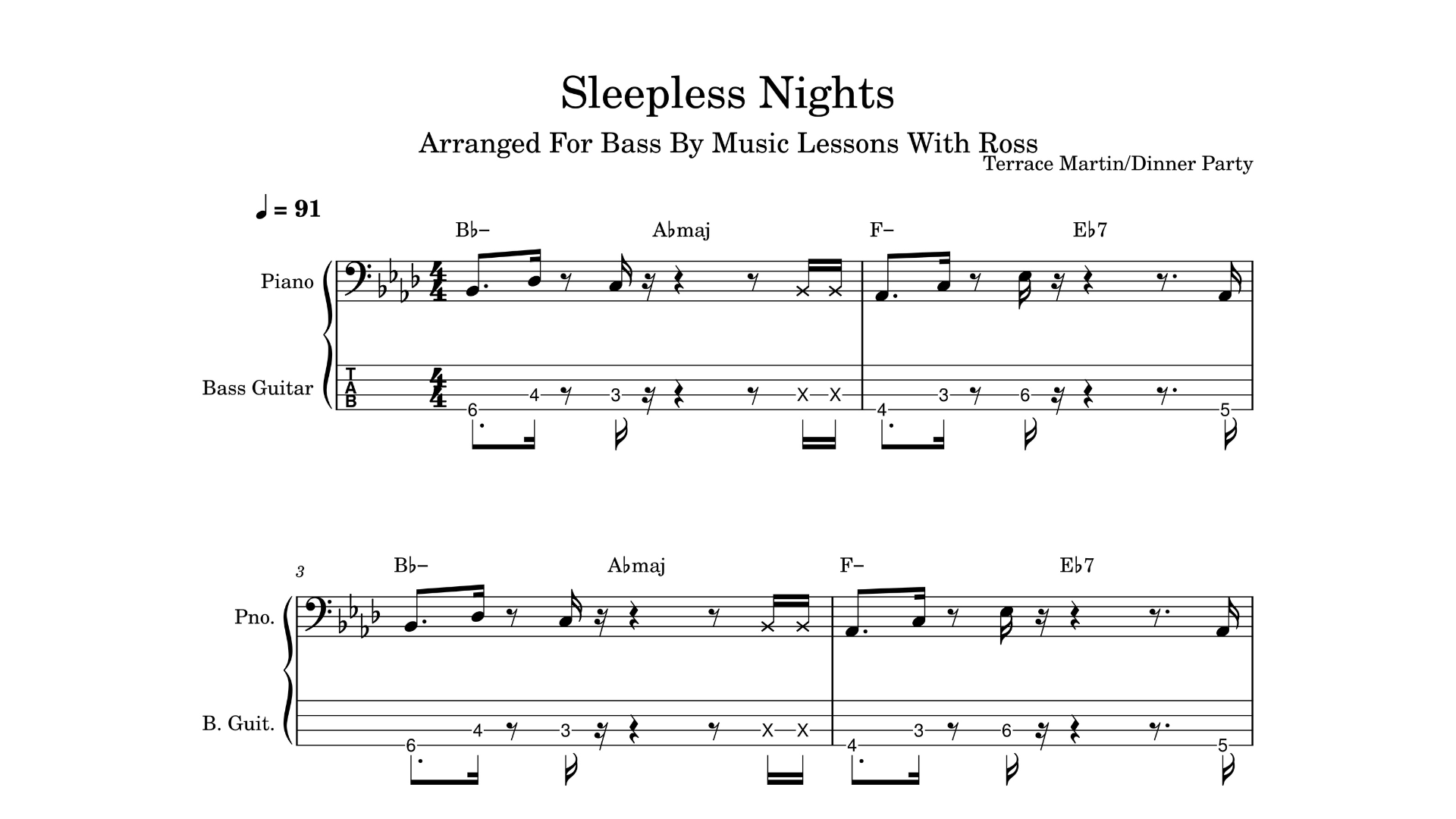
In this arrangement of Sleepless Nights, I've used the same 1/16-note rhythmic phrase at the beginning of each measure. Even as the chords change, the rhythmic shape remains consistent. This creates continuity, reinforces the groove, and demonstrates a fundamental principle of bass line construction: repeating a rhythmic idea while adapting the notes to the harmony.
This approach also strengthens the connection between the bass and drums. Just as drummers use recurring patterns to define the feel of a song, bassists use repeated rhythmic phrases to create stability and lock into the groove. Together, these repeated patterns are what help establish the pocket and give modern Hip Hop bass lines their forward motion.
As you listen to the arrangement, pay attention to how the repeated rhythmic phrase creates a sense of familiarity even when the notes change. This is one of the foundational concepts of Groove Theory and an essential skill for creating stronger bass grooves.
For a deeper exploration of repetition and groove construction, be sure to read the Groove Theory lesson.
Note duration analysis
Most bassists spend their practice time focusing on where notes begin but rarely pay the same attention to where notes end. As a result, notes often ring longer than intended, creating unnecessary tension between the bass, drums, harmony, and melody. This can make a bass line sound muddy, unfocused, and disconnected from the groove.
To develop a stronger bass groove, players need to practice intentional note duration. Every note should occupy a specific amount of space and contribute to the overall feel of the music. Learning to control note length allows the bass to support the rhythm section while leaving room for the other instruments to breathe.
In this arrangement of Sleepless Nights, intentional note duration is highlighted on the + of beat 2. The 1/16-note is cut off almost immediately after it is played. Rather than functioning as a long sustained note, it acts as a short rhythmic stab that creates space before the next phrase. This small detail helps maintain the bouncy, forward-moving feel that defines the arrangement.
Short, staccato note durations are a powerful groove-building tool found throughout modern Hip Hop and R&B bass lines. By controlling where notes end, bassists can create momentum, strengthen the pocket, and improve their connection with the drums.
As you listen to the arrangement, pay close attention to how the short notes create movement and energy. This relationship between note duration and groove is a foundational concept in Groove Theory and an essential skill for constructing effective bass lines.
For a deeper exploration of note duration and groove construction, be sure to read the Groove Theory lesson.
Space analysis
One of the most effective ways to write better bass lines is to use space intentionally rather than constantly adding more notes. While adding complexity can be useful, it often has the opposite effect. The groove loses definition, the bass line becomes cluttered, and you begin competing with the other instruments instead of supporting them.
A better approach is to use space and rests intentionally. In Hip Hop bass playing, space is one of the most powerful tools available for creating pocket, clarity, and forward motion. Learning when not to play is often what separates good bassists from great ones.
Let's look at how space is used in this arrangement.
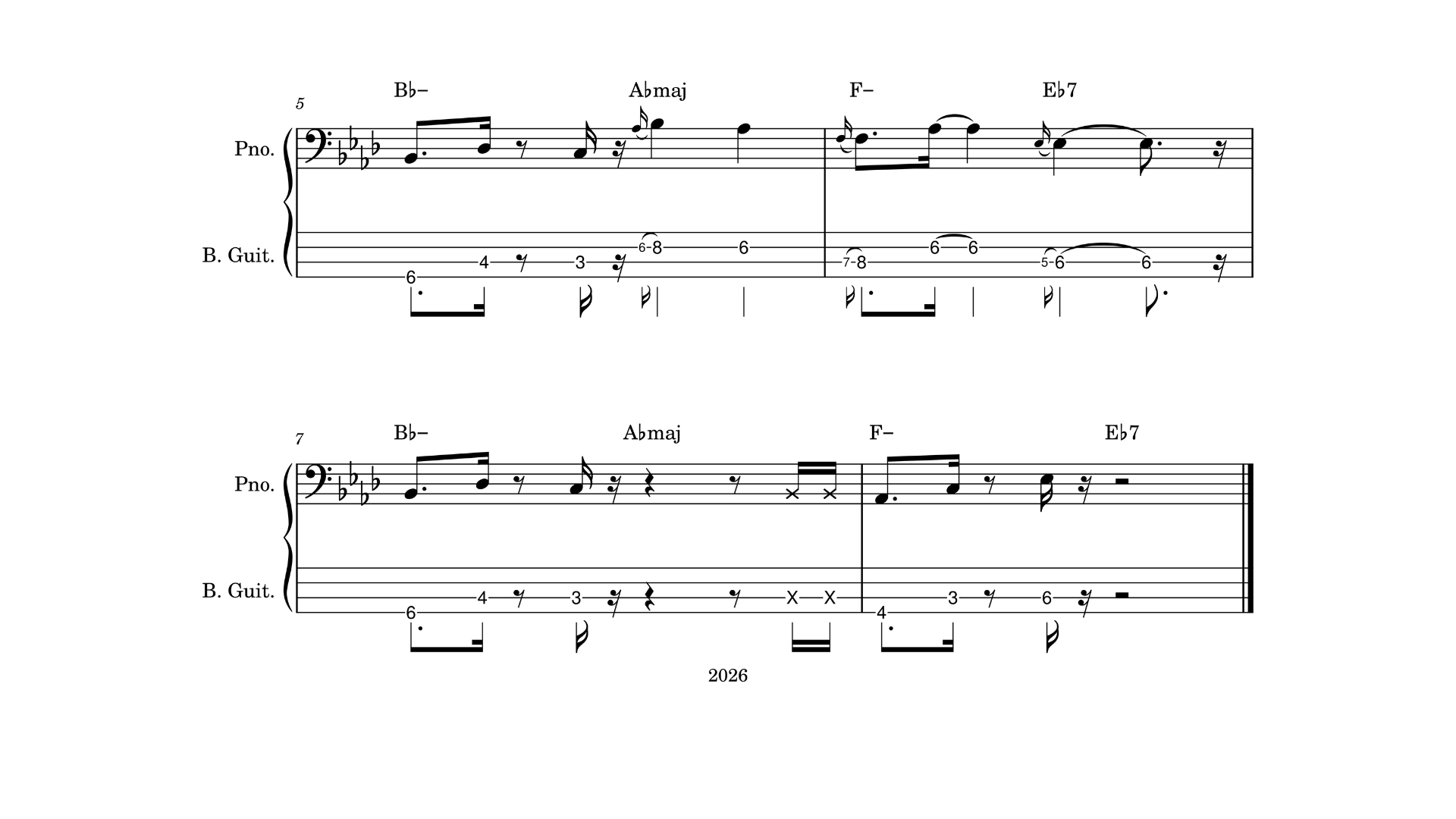
First, the downbeat of beat 2 is consistently left open. Since the snare drum occupies this space, leaving it untouched allows the backbeat to hit harder and gives the groove more definition.
Second, we rarely play on beat 3. This intentional space serves two important purposes. It creates room for the other instruments to contribute to the arrangement, and it builds anticipation for the next bass note. In groove-based music, anticipation often translates directly into perceived motion, making the bass line feel more active even though fewer notes are being played.
Leaving beat 3 open also creates opportunities for variation. Because that space is established throughout most of the groove, a fill or phrase placed there has a much greater impact when it finally appears. In measures 5 and 6, we introduce a legato phrase on beat 3. Those notes stand out and enhance the groove precisely because the space was left open in the preceding measures.
When constructing a Hip Hop bass line, remember that groove is not created by playing more notes. Often, the strongest bass grooves come from strategically using repetition, note duration, and space to support the music.
For a deeper exploration of space and groove construction, be sure to read the Groove Theory lesson.
Drills That Build the Skills Behind Groove, Space, and Note Duration
Understanding groove is one thing. Executing it consistently is another.
The following drills develop the timing, technique, and note control needed to apply repetition, space, and note duration in your own bass lines.
The concepts of repetition, note duration, and space are what create pocket in Hip Hop and R&B bass lines. But understanding these ideas is only the first step. The real question is: what drills help you develop the ability to actually use them when playing bass?
These concepts matter because groove is not created by notes alone. Groove emerges from the decisions bass players make about what to repeat, what to emphasize, and what to leave out.
A strong Hip Hop bass groove depends on one foundational skill: consistent internal rhythm. Without it, concepts like space and repetition lose their impact.
One of the simplest but most effective ways to develop this is the Up/Down drill. This exercise connects your physical motion to time. Move your head or heel with the pulse of a metronome or drum loop, then add plucks on each downbeat. This builds a direct relationship between physical feel and rhythmic placement.
From there, you can expand into subdivision control, which is essential for modern bass groove and pocket playing. Start with the Up/Down drill, then begin adding plucks on different subdivisions:
Downbeats only
Upbeats only
Both downbeats and upbeats
This forces you to hear and feel how subdivisions shape the groove, rather than just count them.
The next step is moving beyond counting entirely and developing internal pulse and feel-based timing. The Ahead / Behind / On drill is designed for this. Play a repeated bass phrase in three ways:
slightly ahead of the click
slightly behind the click
directly on top of the beat
The goal is not perfection. The goal is awareness. This exercise develops a deeper, more intuitive relationship with rhythm—one that counting alone cannot produce.
Over time, these drills help shift your playing from “measured rhythm” to “felt rhythm,” which is where Hip Hop bass grooves begin to feel natural, relaxed, and controlled.
You can explore these concepts further in the Time and Internal Pulse lesson, where these drills are broken down in more detail.
Technique Drills That Improve Groove and Note Control
The technique you use when playing bass has a direct impact on your ability to improve bass groove and control note duration. In Hip Hop and R&B bass playing, even small inconsistencies in plucking, muting, or fretting can weaken the pocket and reduce clarity in the bass line.
These drills are designed to build consistent bass technique, improved note control, and stronger groove execution.
Alternate Plucking Drill
One of the most effective ways to build consistent plucking technique is the Alternate Plucking drill.
Start by anchoring your thumb either on the pickup, the E string, or the nearest stable string. From there, pluck throughthe string (not upward) using your index finger, then your middle finger. Continue alternating fingers with each note.
This develops:
consistent articulation
even note volume
stable rhythmic execution
stronger groove control
Over time, this creates a more balanced and predictable right-hand technique, which is essential for tight Hip Hop bass lines.
Muting Drill (Note Duration Control)
Next is the Muting drill, which is one of the most important skills for controlling note duration and groove clarity.
As you alternate plucking, allow the next finger in your sequence to lightly touch the string after each note to mute it before the next pluck. This creates intentional separation between notes and prevents unwanted ringing.
Start slowly:
One pluck = quarter note
One mute = quarter note
Then repeat the cycle with consistent timing.
This drill builds awareness of note length, space, and articulation, which are all essential components of bass groove and pocket.
Fretting Hand Finger Control Drill
Finally, your fretting hand plays a major role in overall groove consistency. A strong bass line depends on comfort and control across all four fingers—especially the pinky, which is often underdeveloped.
Start by playing notes on a single string in sequence:
Index finger → middle finger → ring finger → pinky finger
Focus on staying relaxed and consistent as you move across frets.
This drill improves:
fretting hand independence
finger strength and control
note accuracy
overall bass line fluidity
Neglecting the pinky often creates uneven bass lines, especially at faster tempos or more syncopated Hip Hop grooves.
Explore Further
You can explore these concepts in more depth in 3 Bass Technique Exercises That Instantly Improve Your Groove, where each drill is broken down in detail with practical applications for Hip Hop bass playing.
Groove Is Built Through Decisions
Learning how to write a bass line isn't just about choosing notes. It's about making intentional decisions about repetition, note duration, and space. These groove-building tools are foundational to Hip Hop bass playing and can be applied to virtually any style of music.
Many bass players search for better notes, more advanced scales, or more complex techniques when trying to improve their grooves.
In reality, great bass lines are often built from a handful of simple decisions.
What do you repeat?
What do you leave out?
How long should each note last?
The answers to those questions shape the groove far more than the notes themselves.
The concepts explored in this lesson—repetition, note duration, and space—are just one part of the larger Groove Lab framework. If you'd like to continue developing these skills, explore the related Groove Theory, Time & Internal Pulse, and King Kunta Groove Study lessons.