
Voice Leading for Bass: How to Connect Chords and Write Smoother Bass Lines
Why do some bass lines sound connected while others feel jumpy?
Two bass players can play exactly the same chord progression.
Both choose the correct notes.
Yet one bass line feels smooth and musical while the other feels disconnected.
The difference is often voice leading.
What is voice leading?
Voice leading is the practice of connecting one chord to the next using the smallest and most musical movement possible.
Instead of jumping from root to root, bass players choose notes that naturally lead into the next harmony.
Good voice leading creates smoother bass lines, clearer harmony, and stronger melodic flow.
How To Use Voice Leading
Instead of thinking:
“What’s the next root?”
You start thinking:
“What’s the nearest note I can move to?”
Here’s the hierarchy of smooth movement:
Half step (minor 2nd) → smoothest possible motion
Whole step (major 2nd) → still very connected
Minor 3rd → slightly more movement, still musical
Major 3rd → edge of smoothness
👉 Anything beyond that begins to sound like a jump, not a connection.
This is the foundation of voice leading:
Minimize distance
Maximize connection
Let lines flow instead of leap
Why It Matters
A strong bass line lives at the intersection of two things:
👉 Groove + Clarity
Groove → how the line feels rhythmically
Clarity → how clearly the harmony is expressed
When those two are working together, the bass line feels grounded and intentional.
Now add voice leading:
👉 Closest note movement between chords
This is where things level up.
Because now:
The groove feels consistent
The harmony connects smoothly
The line becomes memorable
👉 This is how bass lines turn into earworms
Not through complexity, but through:
Strong placement
Clear harmonic movement
Smooth transitions
Visualizing Voice Leading
To make this concept practical, I like to visualize it.
I’ve created a series of graphs that map out:
The notes of each chord
The intervallic distance between every possible note pair
This allows you to quickly identify:
👉 the closest available note when moving between chords
Example 1: D Major → G Major
This graph shows:
All notes in D major
All notes in G major
The distance between each note
From here, you can immediately see:
Where half-step resolutions exist
Where whole-step connections are available
Which movements are smooth vs. which are jumps
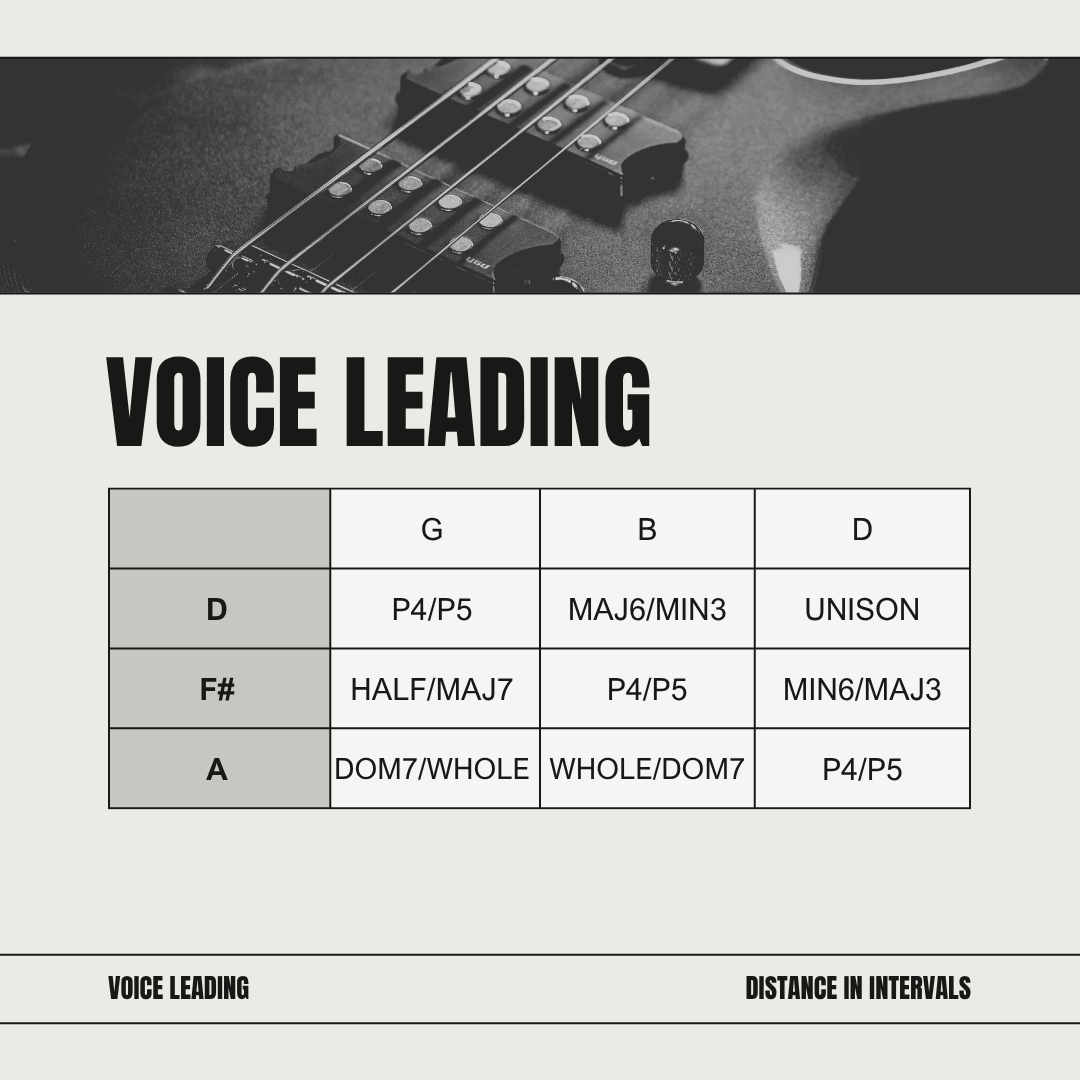
Voice Leading Map: D Major → G Major (Closest Note Connections)
Example 2: C# Minor → F Major
This example introduces more contrast between chords.
The graph highlights:
Less obvious connections
Chromatic movement opportunities
How voice leading works even when chords feel less related
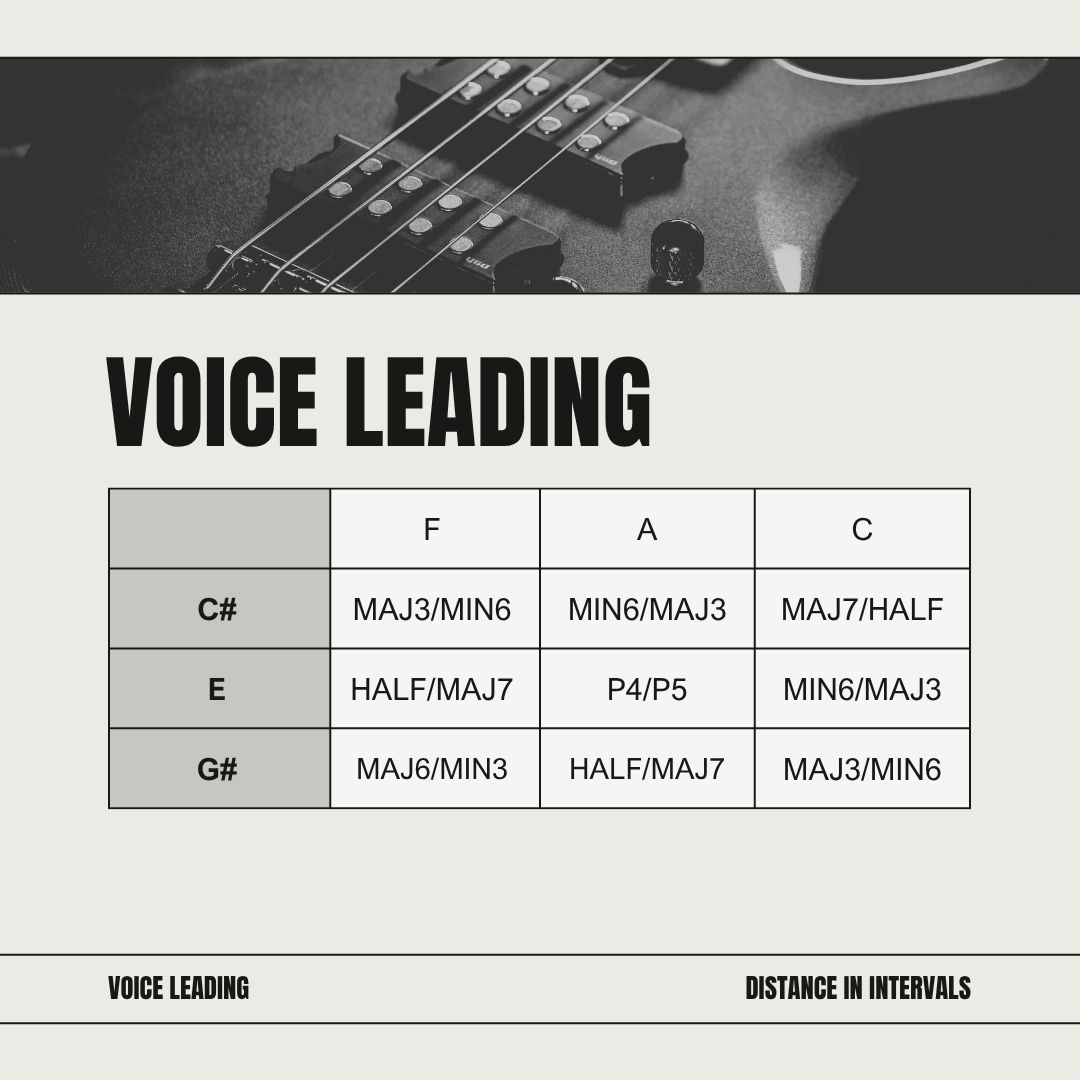
Voice Leading Map: C# Minor → F Major (Closest Note Connections)
Example 3: Application
Finally, I apply this system to the progression used in the J Dilla Backing Track
G minor → F minor → Bb7
This is where the concept becomes musical.
Instead of guessing your way through the changes, the graph shows:
The most efficient pathways between chords
Where tension and resolution naturally occur
How to construct lines that feel connected across the entire progression
These graphs aren’t just theoretical, they’re a tool for training your ear and your hands to recognize proximity in harmony.
Over time, this awareness becomes instinctive.
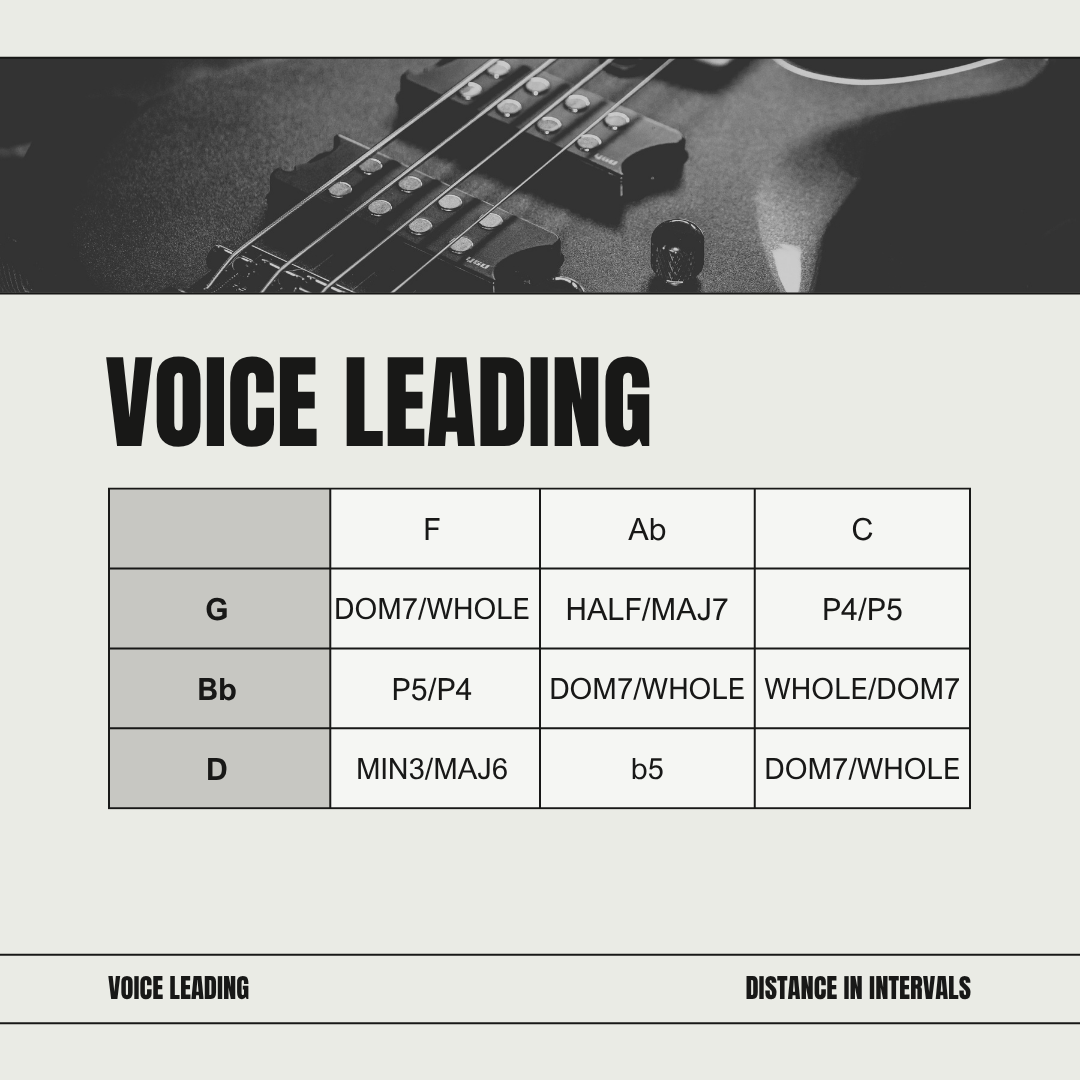
Voice Leading Map: G Minor → F Minor (Closest Note Connections)
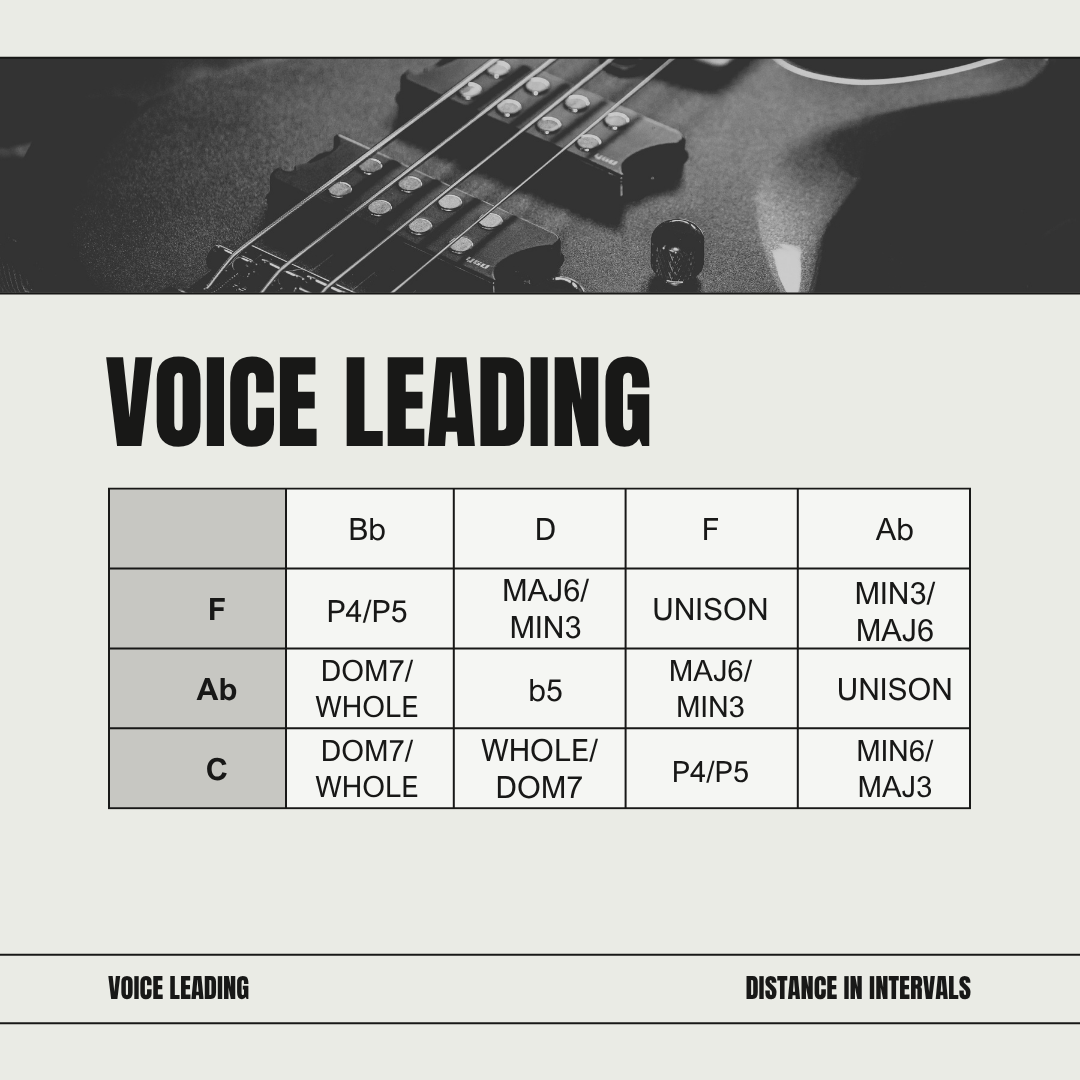
Voice Leading Map: F Minor → Bb Dominant (Closest Note Connections)
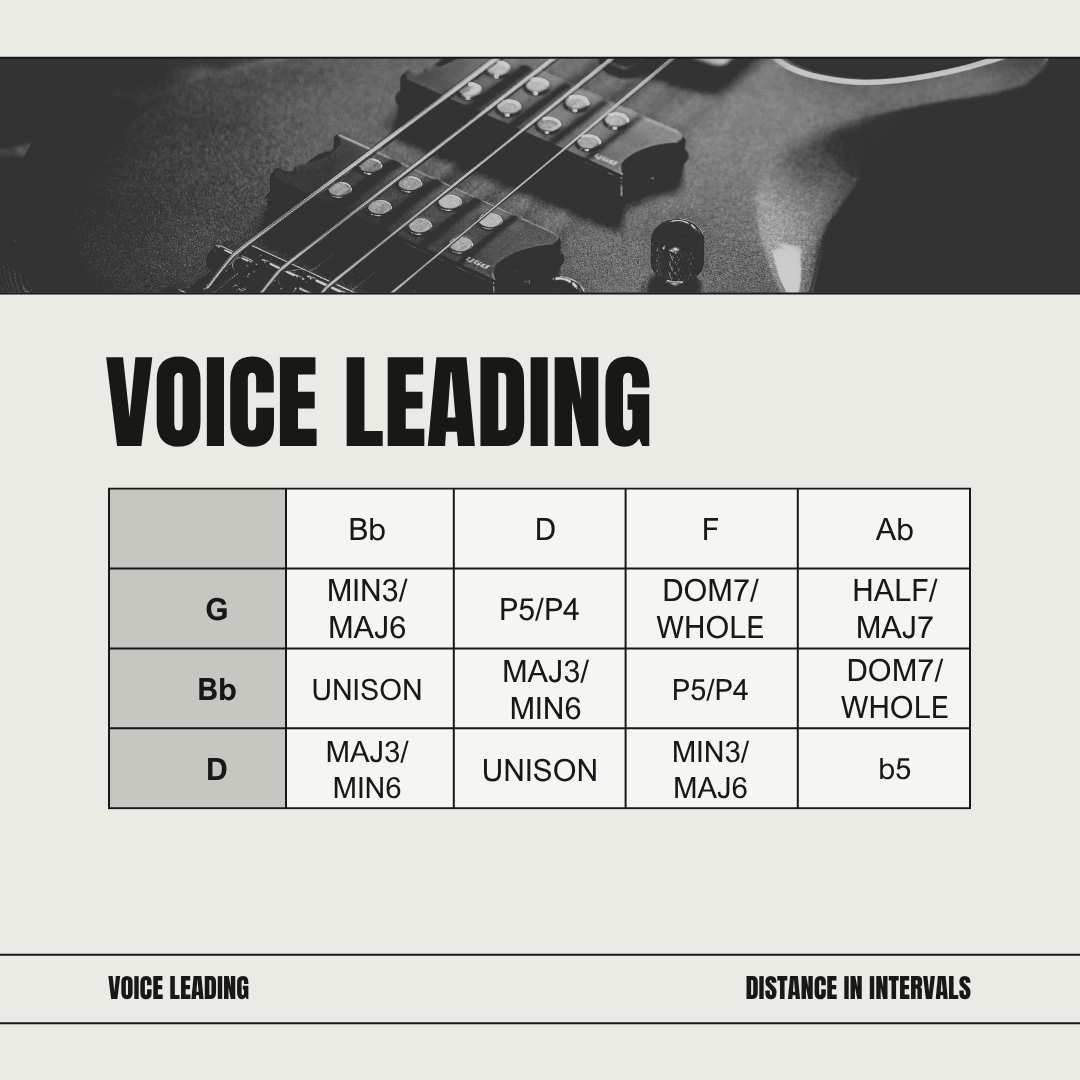
Voice Leading Map: Bb Dominant → G Minor (Closest Note Connections)
Practical Application
Voice leading is about choosing closer notes to create harmonic motion.
The smaller the movement, the stronger the connection.
And the stronger the connection, the more musical your bass lines become.
Next time you’re working on a bass line:
Identify the current chord
Look at the next chord
Find the closest available note
Half step → first choice
Whole step → second
Minor 3rd → third
Major 3rd → last “smooth” option
Build your line from that connection
This is only one side of the equation.
Voice leading determines what notes you choose.
Groove determines when you place them.
When both are working together, your bass lines don’t just function, they feel right.
If you want to take this further:
Explore how rhythmic placement shapes feel → Dilla Groove Video
Dive deeper into identifying notes of a chord → How To Read Chord Charts
Practice this directly → Free Practice Kit
Your Next Step
Groove Lab Studyies are free guided studies built around custom backing tracks. This lesson is Step Six: using voice leading to create smooth transitions between chords. After completion submit your analysis to your teacher.
Step Seven is practicing the entire bass line you wrote using the Practice Cycle to document and submit your work to your teacher.